
Article Text
Please comply with the laws and regulations of the country in question regarding the possession and use of drugs.
In Part 2 of the interview, we trace the process in Canada from 2008 to 2018, where legal battles, institutional reforms, and on-the-ground practices mutually influenced each other, ultimately leading to full legalization.
table of contents
- Introduction
- [Exclusive Interview Part 2] How did we change the law? (2008-2018)
- The story of how they won the trial, and why the "Compassion Club" stood in court.
- Question
- Reply
- Why filing a lawsuit can be the most powerful means of changing society
- Social change and social acceptance, how did it change people's attitudes?
- In 2018, the law finally changed. Who was it that influenced the politicians?
- 2015-2018 Timeline
- Features common to all sheets
- Articles that could not be found in online reports
- Common misconceptions revealed in news reports
- Regarding the US Federal Marijuana Rescheduling Hearing on June 29, 2026
- Issues remain after legalization in 2018; progress is being made, but not perfect
- A message from a senior colleague: "First, find at least one person who understands you."
- It's not just demonstrations. There are so many other forms of "protest."
- The strategic significance of Shop Vape Lounge
- The risks and sacrifices of being caught, and the reasons for continuing the citizen movement
- Reply
- The accumulation of transforming ideals into systems, as seen in Part 2 of the interview.
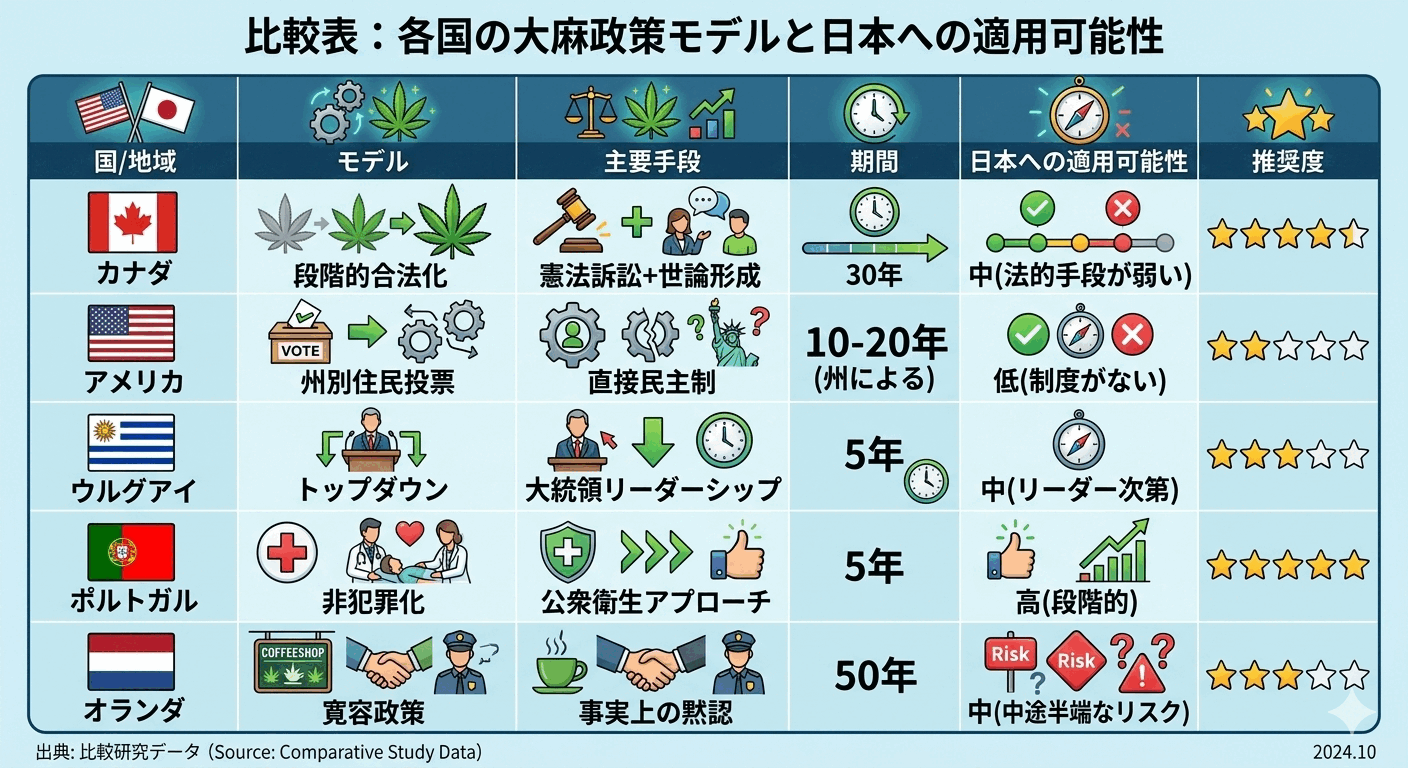
- Let's compare "success stories" from around the world.
- The American way of changing things through "referendums" in each state.
- The main means of legalization is a ballot initiative.
- The Uruguayan way: The day the president decided to "do it himself."
- The role of President Jose Mujica
- Results and challenges
- What changed just by the Portuguese approach of "stopping treating it as a crime"?
- What decriminalization entails
- International Recognition
- The Netherlands: A country where the "turning a blind eye" mentality has become the norm.
- The idea of "tolerance policy"
- "Front door/back door problem"
- Frequently Asked Questions (FAQ) about citizen movements and lobbying activities
- Will participating in a civic movement cause any disadvantages in the future (such as in terms of finding employment)?
- Are we going to turn this into a litigious country like America, making it a difficult world to live in?
- In Japan, the words "advocacy" and "lobbying" have negative connotations such as "pressure groups" and "profiteering." How should we respond?
- It might give the impression that I have strong "ideologies."
- Isn't Japan's bureaucracy closed and unwilling to listen to outside voices?
- Have you ever had your research and proposals stolen by politicians or bureaucrats?
- If you work hard on a lawsuit but don't get any results, or if your achievements are stolen, isn't it not worth it?
- Is it because public opinion is conservative and there is strong resistance to new things?
- I'm nervous about starting on my own. Are there any organizations I can join?
- I've heard that forming alliances between citizen groups, researchers, and businesses is effective, but in reality, I feel that internal conflicts and disputes are very common within reformist organizations. What should be done?
- I want to meet a politician, but how do I make an appointment?
- You say you need data and expertise, but where do you get it?
- How should you respond to opposition and criticism?
- Isn't it true that individuals who "stand out" have low social acceptance? Isn't it dangerous?
- I don't have the expertise...
- I'm busy with work and I don't have time...
- No funds...
- There's a prevailing sentiment that "goodwill activities should be volunteer work," and the lack of a tipping culture makes fundraising highly unwelcome. In one instance, a prominent national constitutional scholar, an emeritus professor, refused to comment, stating he "cannot respond to requests from private companies." How can we overcome these economic sustainability (ecosystem) barriers?
- Is there any point in starting alone?
- I'm afraid of failure...
- After it was legalized, what happened to the crimes of those who were arrested and convicted before then?
- Even though it's said to be a long-term battle, I'm worried about whether I'll be able to maintain my motivation.
- Summary
- Total
- Comment:
[Exclusive Interview Part 2] How did we change the law? (2008-2018)
The story of how they won the trial, and why the "Compassion Club" stood in court.
Question
How did the incident with your friend Matt Baron happen?
Reply
He was arrested by the police for growing cannabis for the Compassion Club and went through a lengthy trial that lasted six or seven years.
"What you're doing is helping people and is a necessary service to society."
He ruled that he was successful.
It is important to emphasize that most compassion clubs, including the Vancouver Compassion Club (VCC), were run on a non-profit model. They were not profit-driven.Pure kindness and a moral compass to help those suffering from illnessIt has been active since.
Interestingly, even before legalization, the government tried to impose exorbitant taxes on their sales. They were in a contradictory position, wanting to collect tax revenue while refusing to legalize the business. The clubs were on the brink of closing down, but a solution was eventually reached.
Besides Matt Baron's case, several other important precedents have emerged. In the trial of R.V. Belen, who cultivated cannabis at VCC, the "Designated Grower" system, which allows patients to request cultivation, was recognized. In the case of R.V. Owen, who worked as a baker at VCC and other clubs, it was recognized that cannabis can be consumed not only by inhalation but also by food. This was a particularly important ruling for non-smokers and patients with respiratory diseases such as COPD (chronic obstructive pulmonary disease).
In this way, the law changes with each court case.
What exactly is a "Compassion Club"?
This refers to a civic group that emerged in Canada in the 1990s to safely deliver medical cannabis to patients with serious illnesses. At the time, the system was not yet in place, and there were very few ways for patients to obtain it legally. Therefore, a system spontaneously arose where only patients diagnosed by a doctor could become members, cannabis was provided on a membership basis, and consultation, information sharing, and psychological support were offered.
Case study: R. v. Beren and Swallow (2009 BCSC 429)
事件
| Item | Message |
|---|---|
| defendant | Mat Beren / Gregory Swallow |
| court | British Columbia Supreme Court |
| year of judgment | 2009 |
| Event Type | Criminal case concerning the constitutionality of the Medical Marijuana Act (MMAR) |
| Issue | Do MMAR regulations, including the Designated Grower system, comply with Article VII of the Canadian Charter? |
| judgment | Charterary issues have been raised regarding some restrictions on the medical cannabis system. |
Main points of contention in the trial
- The rights of cannabis users for medical purposes (Article 7 of the Canadian Charter)
- Is the Medical Marijuana Act (MMAR) excessively restricting patient access?
- The rationality of the Designated Grower system regulations
- Medical cannabis supply system and public interest
This case is often cited, along with later medical cannabis trials (such as R. v. Smith and Allard v. Canada), as an example illustrating the issues of the "designated grower" system and restrictions on patient access within the medical cannabis system.
Case law and reference materials
-
Full text of the case (CanLII)
R. v. Beren and Swallow, 2009 BCSC 429 -
Case Commentary (Osgoode Hall Law School)
R v Beren: Exemptions for Medical Marijuana under s.7
The impact of this ruling
legal implications
| Level | 影響 |
|---|---|
| Individual incidents | Barron's innocence |
| Similar incident | Positive impact on other compassion club operators (as a legal precedent) |
| government policy | Pressure to improve medical programs |
| public opinion | Spread of awareness that "patients should not be treated like criminals" |
social impact
- Barron v. decision (around 2009) ↓
- The activities of the Compassion Club have been quasi-legalized.
- Substantial improvement in patient access ↓
- Improvement in the social acceptance of medical cannabis ↓
- 2018: The foundation for full legalization
The influence of legal precedents in Japan
constitutional scholarNobuyoshi AshibeIn his book "Theory of Constitutional Litigation," he states that "Although Japanese precedents have little legal binding power, they do have a certain influence on shaping public opinion, subsequent trials, and even legislation."
Landmark decisions such as the Barron decision in Canada may not be legally binding on other courts.A catalyst for social debateThis is a strategy that can be utilized in Japan as well.
The legal doctrine of "Necessity Defense"
The concept used in this trial was the common law "defence of necessity".
Three requirements for the defense of necessity to be valid
- Imminent danger: Obeying the law will result in serious harm
- Lack of other legal options: No other options available
- Proportionality: Harm caused by unlawful act < Harm prevented
Matt Baron's case met all three of these requirements perfectly.
In criminal law, there is a theory that even if an act formally meets the elements of a crime, if it is not substantively illegal, the illegality is precluded. Typical examples are "self-defense" and "emergency escape," but this theory is discussed as a general principle that is not limited to these.
Matt Baron's case also aligns with this theory in the following respects:
- balance of legal interests: The legal interest protected (patient's life and health) is greater than the harm caused by the violation of the law (violation of drug control laws)
- replenishment: There were no other legal options (government programs were not working)
- 相当性: The nature of the act was appropriate in light of the purpose (non-profit, patient support purpose)
"Emergency Evacuation" in Japanese Criminal Law
Article 37 of the Japanese Penal Code stipulates the concept of "emergency defense."
"An act done out of necessity to avoid present danger to one's own or another's life, body, freedom, or property shall not be punished if the harm resulting from it does not exceed the harm that was sought to be avoided." Article 37 of the Japanese Penal Code (Emergency Evacuation)
This provision is similar to Canada's "defense of necessity." The requirements are as follows:
- 現在の危難: There is a real danger to life, body, freedom, or property.
- replenishment: It was an act of necessity (there was no other way)
- balance of legal interests: The harm caused does not exceed the harm sought to be avoided
Applying Matt Baron's case to Japanese criminal law,
- 現在の危難: Danger to the patient's life and health (serious symptoms)
- replenishment: The government's health care program wasn't working, and there was no other option.
- balance of legal interests: Harm caused by violation of drug control laws < Protecting patients' lives and health
In theory, it is possible to claim innocence on the grounds of "emergency evacuation" in Japan as well.
Why filing a lawsuit can be the most powerful means of changing society
In Canada, laws are rarely changed by Parliament alone. In most cases, they are only amended after a constitutional lawsuit finds that the law unduly restricts people's lives.
Legal reform mechanisms for cannabis legalization in Canada
| Route | Outline | Key Points |
|---|---|---|
| Route 1 | Voluntary legislation by parliament | Political consensus needed |
| Route 2 | Court ruling of unconstitutionality | The government is effectively being forced to amend the law. |
| Route 3 | Political decisions influenced by public opinion pressure | Realized through election promises and public support |
Japan's legal reform mechanism
In Japan, the Canadian route (2) (enforcement of legal reform by the judiciary) only works to a limited extent. Instead, the following mechanisms are important.
| Route | Outline | Characteristics | Strength of the influence |
|---|---|---|---|
| Route 1 | Parliamentary legislation (major) | Most bills are drafted by bureaucrats | Strong (central route) |
| Route 2 | Court rulings unconstitutional (rare) | Although the law was ruled unconstitutional, its direct impact on policy formation was limited | Limited |
| Route 3 | Public opinion and media pressure | Indirect influence on politicians and bureaucrats | 中 |
| Route 4 | Academic and expert recommendations | Reflection in policy through councils and expert meetings | 中 |
Therefore, in Japan,Multifaceted approach to not only courts but also bureaucrats, councils, experts, and the mediaIs essential.
Canadian Charter of Rights and Freedoms
This charter, enacted in 1982, became a powerful weapon for the citizens' movement.
Particularly important provisions
| article | Message | Application in cannabis lawsuits |
|---|---|---|
| Article 7 (Life, Liberty, Safety) | "Everyone has the right to life, liberty and security of person" | Right to access medical care |
| Article 15 (Right to Equality) | "Equality under the law, freedom from discrimination" | Unequal treatment of patients |
The power of the charter
Supreme Court of Canada, past decisions (Hunter v. Southam,Big M Drug Mart Judgment etc.)
The Supreme Court of Canada has repeatedly confirmed that the introduction of the Charter of Rights and Freedoms transformed Canada's constitutional order from one of parliamentary supremacy to one in which the courts can invalidate laws that violate fundamental rights.
Comparison with the Japanese Constitution
Article 7 of the Canadian Charter, "the right to life, liberty and security of person," corresponds to Article 13 of the Japanese Constitution, "the right of people to life, liberty and the pursuit of happiness."
constitutional scholarNobuyoshi AshibeHe interprets Article 13 of the Constitution as "guaranteeing new human rights that are not specifically enumerated, as comprehensive human rights" (Nobuyoshi Ashibe, "Constitution"). Based on this interpretation, the "right to receive medical care" and the "right to self-determination" may also be guaranteed by Article 13.
Furthermore, the "right to equality" in Article 15 of the Canadian Charter corresponds to the "equality under the law" in Article 14 of the Japanese Constitution.
In theory, the following constitutional lawsuits are possible in Japan:
- Article 13 of the Constitution (Respect for the Individual)Violation of the right to medical care and the right to self-determination
- Article 25 of the Constitution (Right to Life)Violation of the right to a minimum standard of healthy and cultural living
- Article 14 of the Constitution (Right to Equality): Unreasonable discrimination against patients
The judicial and legislative cycle
Canada's cannabis-related cycle
- ① Patients suffer under current laws
- ② File a constitutional lawsuit
- ③ The court ruled the law unconstitutional.
- ④ Order the government to amend the law (usually with a grace period of 1-2 years)
- ⑤ The government amends the law
- ⑥ However, the new law is also insufficient.
- ⑦ Constitutional litigation again → Return to ①
This cycle continued for about 20 years, culminating in full legalization in 2018.
The cycle of "lawsuit → public opinion → legislation" in Japan
In Japan, it is rare for courts to directly order legal reforms, but the following cycle works:
- ① Social problems become apparent
- ② Lawsuit filed (attracts media attention)
- ③ The courts are cautious (and often lose).
- ④ However, public opinion shifts
- ⑤ Media and experts raise issues
- ⑥ Politicians and bureaucrats begin discussions.
- ⑦ Establishment of a council and preparation of a report
- ⑧ Legislative bodies amend laws
Case example: National compensation lawsuit for leprosy
On May 11, 2001, the Kumamoto District Court ruled that the long-term isolation policy based on the former Leprosy Prevention Law was unconstitutional (Kumamoto District Court Judgment, May 11, 2001). Following this, the government abandoned its appeal and decided to issue an apology and compensation.
Primary sources and official evidence
- Kumamoto District Court ruling (May 11, 2001)
Official court website (case law information)- Apology by the Prime Minister (May 23, 2001)
Official Records of the Prime Minister's Office- Act on Promotion of Resolution of Hansen's Disease Issues (Act No. 63 of 2001)
e-Gov Law SearchThis case shows that
- In cases of clear human rights violations, Japanese courts may also rule the law unconstitutional.
- The ruling could influence public opinion and political judgment, prompting the government to change its policy.
- Litigation can be an opportunity for system reform
International Comparison: Legal Reform Mechanisms
| Country | Main Mechanism | Implications for citizen movements |
|---|---|---|
| Canada | Court-led constitutional litigation | Legal measures are very effective |
| America | State-by-state referendums | Utilizing direct democracy |
| Netherlands | Progressive reform of parliament | Emphasis on political consensus |
| Eur-lex.europa.eu eur-lex.europa.eu | Strong presidential leadership | Top-down reform |
| Japan | Bureaucratic-led gradual reform | The expert and council route is important. However, organizations and experts that rely on government funding face structural constraints that make it difficult to make independent policy recommendations due to considerations and deference to the administration. |
Japan's Challenges
- Constitutional litigation is not effective → Emphasis on raising public opinion
- Limited referendum system → Cooperation with local governments
- Parliament is highly conservative → Influencing bureaucrats and experts
- Top-down reforms are rare → A combined approach
Social change and social acceptance, how did it change people's attitudes?
Another important thing is social change and social acceptance. Attitudes will change as more people start using cannabis and asking, "What's the harm?"
2015-2018 Timeline
The Canadian example shows thatIt took 30 years to build a social consensusThe process by which public opinion shifted from 22% to 68% was the foundation for sustainable legal change.
Trends in support for marijuana legalization (Canada)
| Years | popularity | Main sources | Chief Events |
|---|---|---|---|
| 1990 | Approximately 20% | Gallup Canada (Early 1990s poll) | Civil disobedience during the AIDS crisis |
| 2000 | About 30% |
EKOS Research (2000)
https://www.ekospolitics.com/index.php/2000/05/public-support-for-marijuana-legalization/ | Parker decision (2000) |
| 2003 | 33-36% |
EKOS Research (2003)
https://www.ekospolitics.com/index.php/2003/10/cannabis-opinion/ | Medical system development |
| 2008 | About 40% |
Angus Reid (2008)
https://angusreid.org/legalize-marijuana-canada/ | Expanding institutional discussions |
| 2012 | About 50% |
Angus Reid (2012)
https://angusreid.org/marijuana-legalization-canada/ | Support reaches majority |
| 2015 | 55-60% |
Nanos Research (2015)
https://nanos.co/wp-content/uploads/2017/03/2015-765-CBC-October-19th-2015-Populated-Report-with-Tabs.pdf | Liberal Party wins on legalization pledge |
| 2018 | About 60% |
Angus Reid Institute (2018)
https://angusreid.org/cannabis-legalization-canada/ | Cannabis Act enforcement |
| 2023 | 65-70% |
Angus Reid Institute (2023)
https://angusreid.org/cannabis-five-years-later/ | Evaluation five years after legalization |
*The figures for each year are not a single continuous survey, but representative values based on the results of major opinion polls for that year.
支持率
70%|                                        ●(68%)
|                                    ●(62%)
60%|                                ●(57%)
|                            ●(50%)
50%|                        ●(41%)
|                    ●(35%)
40%|                ●(31%)
|            ●(22%)
30%|        ●
|    ●
20%|●
└────────────────────────────────────────→
1990  2000  2003  2008  2012  2015  2018  2023
A key turning point
- 2012: For the first time, support exceeds opposition
- 2015: A large majority (political feasibility)
The Canadian example isIt took about 20 years (1990 to 2012) to gain majority support.This shows that a long-term strategy for shaping public opinion is essential in Japan as well.
Canada's 38-year history can be seen as a synthesis of all these perspectives.
In 2018, the law finally changed. Who was it that influenced the politicians?
Changing public opinion
A historic moment: On October 17, 2018, Canada became the first G7 country to fully legalize cannabis.
2015-2018 Timeline
| Date | Event |
|---|---|
| June 2015 | Liberal Party wins election, Trudeau becomes Prime Minister |
| June 2015 | Legalization officially confirmed as a campaign promise |
| June 2016 | A task force on cannabis legalization has been established. |
| June 2016 | Task Force Report Released |
| June 2017 | Bill C-45 (Cannabis Bill) submitted |
| June 2017 | Passed by the House of Representatives |
| June 2018 | Passed by the Senate and enacted |
| October 17, 2018 | Enforcement |
Analysis of Coverage Trends in Major Japanese Media Regarding Canada's 2018 Cannabis Legalization
This study compares and analyzes how major Japanese media outlets reported on Canada's legalization of marijuana (October 17, 2018), using the original articles from Asahi, Sankei, Yomiuri, Tokyo Shimbun, Mainichi Shimbun, and Nikkei (Survey date: June 25, 2026).
Features common to all sheets
- It was reported in the international news section and treated as diplomatic and international news.
- The focus is on straightforward news reporting the facts of the system change, not on editorials or commentaries.
- All newspapers mentioned the protection of minors and the regulations they envisioned.
- The relationship between the civil rights movement and opioids, as well as the actual social context, are hardly addressed.
- Each company is taking a cautious stance regarding its future prospects.
Asahi Shimbun
- date:October 19, 2018
- Page where it was published:International section, page 11
- Article length:Approximately 650 characters
- tone:Careful
- Claim:Background to legalization, impact on industry, and health risks
Sankei Shimbun
- date:October 18, 2018
- Page where it was published:International section, page 9
- Article length:Approximately 200 characters
- tone:Neutral
- Claim:First legalization in the G7: System Overview
Yomiuri Shimbun
- date:October 18, 2018
- Page where it was published:International section, page 7
- Article length:Approximately 320 characters
- tone:Careful
- Claim:First legalization in the G7: System Overview
Tokyo Newspaper
- date:October 18, 2018
- Page where it was published:International section, page 9
- Article length:Approximately 600 characters
- tone:Neutral
- Claim:Background of legal systems, industries, amnesties, and legalization
Mainichi Newspapers
- date:October 18, 2018
- Page where it was published:International section, page 8
- Article length:Approximately 250 characters
- tone:Careful
- Claim:The first legalization in the G7, the legal framework, and the background of legalization.
Nihon Keizai Shimbun
- date:October 17, 2018
- delivery:Kyodo News (New York)
- tone:Careful
- Claim:The Trudeau administration explained its aim was to eliminate drug trafficking organizations and make it more difficult for minors to obtain cannabis. While cannabis-related companies are focusing on developing new products, concerns about health effects have led to the report stating that "the future is uncertain."
- URL:https://www.nikkei.com/article/DGXMZO36589500X11C18A0000000/
Articles that could not be found in online reports
We were unable to find any news articles about the legalization of cannabis in Canada from the following media outlets around October 17, 2018, on their websites. (Date of investigation: June 25, 2026)
- NHK
Common misconceptions revealed in news reports
While various newspapers discussed concerns about "addiction," they failed to clearly define the subject. Because the reports did not distinguish whether they were referring to opioids or cannabis, readers confused opioids and cannabis, leading to the misconception that cannabis carries an addiction risk.
Furthermore, they conflate the situation in Canada with that in Uruguay, reporting on Canada's marijuana legalization in the context of "countering drug trafficking organizations."
Furthermore, while there are mentions of minors in various newspapers, Canada's policy objective of protecting minors was in the context of preventing contamination of minors after legalization, whereas the reports in these newspapers could be misinterpreted as "measures to address the situation where it is already widespread among minors."
In this way, the media coverage has almost completely obscured important contexts such as the potential of cannabis in pain management and the nearly 40-year legal battle of the citizens' movement.
Regarding the US Federal Marijuana Rescheduling Hearing on June 29, 2026
June 29, 2026 is a historic day, as it will be the date of the US federal government's hearing on the reclassification of cannabis. However, as of today (June 25, 2026),I cannot find any articles in major Japanese media outlets that predict or analyze the background of this significant policy shift in the United States.
Economic impact (5 years after legalization)
Pre-legalization predictions (2016)
Estimates by the Canadian Parliamentary Budget Office
- Tax revenue forecast: 356 million to 959 million Canadian dollars
Source: Parliamentary Budget Office (2016) - The median is approximately 618 million Canadian dollars (which is roughly equivalent to the annual budget of a regional city in Japan with a population of around 200,000).
Actual results (post-legalization)
| index | Numerical value |
|---|---|
| Legal cannabis market size (2023) | Approximately 43 billion Canadian dollars (approximately 4,700 billion yen) |
| Government tax revenue (cumulative since legalization) | Approximately 54 billion Canadian dollars (approximately 5,900 billion yen) |
| Government tax revenue (annual average) | Approximately 11 billion Canadian dollars (approximately 1,200 billion yen) |
| Job creation | Approximately 15 people (direct/indirect) |
| Shrinking the black market | Approximately 40-50% (estimated) |
Comparison of forecasts and results
Actual tax revenue (approximately 11 billion Canadian dollars annually, or about 120 billion Japanese yen) significantly exceeded the 2016 forecast (400 to 600 million Canadian dollars annually). This is roughly double the initial estimate.
For reference, this level of tax revenue is equivalent to the economic scale of Japan's fast breeder reactor (FBR) development budget (approximately 1,000 to 1,400 billion yen).
Notes: The economic benefits came later; the original purpose of the movement was to ensure patients' right to access medical care and personal freedom.
Issues remain after legalization in 2018; progress is being made, but not perfect
There are still challenges remaining today.
For example, driving regulations do not distinguish between "presence of alcohol in the body" and "actual intoxication/dangerous driving." Even if you have used alcohol the day before, you may test positive and be punished even if you are not actually at fault.
It's not perfect, but we're making progress.
It's been about seven years since it was legalized for personal use in 2018, and things are definitely getting better.
Above all, the fact that people are no longer being imprisoned for marijuana use is a huge step forward.
Current major challenges (as of 2024)
| Issue Category | specific problem |
|---|---|
| Driving restrictions | Uniform judgment based on THC blood concentration |
| Social Media Regulation | Strict restrictions on advertising and information dissemination |
| Price competitiveness | Legal market more expensive than black market |
| Quality Variety | Limited legal market products |
| Regional differences | Variation in regulations by state |
| Treatment in the workplace | Employment discrimination against employers |
| 国際旅行 | Canadians have problems in other countries |
Problems with driving restrictions, detailed explanation
Current system
血中THC濃度
↓
2ng/mL以上 → 軽微な罰則
5ng/mL以上 → 重大な罰則(飲酒運転と同等)
problem
- Residual duration: THC is fat-soluble and remains in the body for a long time.
- Detectable for 24-48 hours after use
- However, the intoxicating effect lasts for about 2-4 hours.
- Individual differences: Varies greatly depending on metabolic rate and frequency of use
- Lack of scientific evidence: No established standard for "safe" blood levels
Comparison: Differences with Alcohol
| 要素 | alcohol | marijuana |
|---|---|---|
| Correlation between drunkenness and blood concentration | high | Low |
| Reliability of the test | high | 中 |
| Scientific consensus | strong | weak |
| Establishing safety standards | Established (BAC 0.08%) | Not established |
Dr. Jeffrey Brubacher (Emergency Medicine) of the University of British Columbia
Emergency medicine specialist Jeffrey Brubacher (UBC) criticizes the uniform numerical criteria based on blood THC levels, arguing that they lack scientific basis and merely punish the "presence" of THC rather than the actual impairment of driving ability. Dr. Jeffrey Brubacher (Emergency Medicine), UBC Faculty of Medicine
Strict social media regulations
Contents of the regulation
- Advertising for cannabis products is almost completely banned (regulated to the same extent as tobacco).
- Frequent account bans on Instagram, Facebook, YouTube, etc.
- Even educational content is restricted
- Excessive self-regulation by media platform companies (Meta, Google, TikTok, etc.)
"The reason my name includes 'Calyx and Trichomes' is because Zoom displays business account names. However, our accounts are often banned very quickly. This is largely due to the influence of the United States." Jennawae Cavion, NORML Canada 2025
Problems with this regulation
- hinder the flow of accurate information
- Hindering efforts to eliminate stigma
- Disadvantages to legal businesses (black markets are not regulated)
The current situation in Japan (2026)
For educational purposes, content can be published on platforms like Instagram, Facebook, and YouTube. However, the revised Information Distribution Platform Countermeasures Act (effective April 1, 2025), enacted in 2024, strengthens the transparency and accountability of platforms and imposes stricter regulations by the government. On the other hand, Chinese platforms such as TikTok apply their own strict standards, so extra caution is necessary.
Overall assessment five years after legalization
Successful points
- Annual arrests: From about 5 to almost 0
- Significant reduction in stigma
- Creation of new industries (employment and tax revenue)
- Youth use rates: No significant change (the feared increase did not occur)
Remaining issues
- Black market still 40-50%
- Lack of scientific basis for driving restrictions, etc.
- Strict social media regulations
- International travel restrictions
comprehensive evaluation
Jennawae Cavion, NORML Canada 2025
"It's not perfect, but it's definitely better than it was before."
This is the reality of any social reform: it shows the importance of moving forward imperfectly rather than striving for perfection and doing nothing at all.
A message from a senior colleague: "First, find at least one person who understands you."
Dealing with bureaucracy requires patience.
The only way to achieve this is to find politicians and judges who sympathize with us and bring about change little by little.
Are there any politicians or judicial officials in Japan who understand this idea?
The importance of "finding someone who understands"
Try to persuade everyone
- Trying to persuade everyone (impossible)
- setback
- Giving up
Find someone who understands and empathizes with you.
- Finding someone who understands and empathizes with you (possible)
- Small success
- Network Expansion
- Increasing influence
Strategically important "understanding people"
| Category | Example : | Importance |
|---|---|---|
| 政治家 | Innovative young politicians and veterans nearing retirement | ★ ★ ★ ★ ★ |
| Officials | People who are aware of problems at a practical level | ★★★★ ☆ |
| judge | A judge with a strong sense of human rights | ★★★★ ☆ |
| Academics and Researchers | Someone who can back it up with specialized knowledge | ★ ★ ★ ★ ★ |
| ジャーナリスト | Media professionals who are aware of the issue | ★★★★ ☆ |
| Business leaders | Someone who supports you with economic logic | ★★★ ☆☆ |
Important: These people may not be supportive to begin with. Finding a persuasive middle ground is key.
The Art of Dialogue: Applying Harvard Negotiation Techniques
Six principles of negotiation as taught at Harvard University
| principle | Description | Application to citizen movements |
|---|---|---|
| Put Yourself in Their Shoes | Understand the situation from the other person's perspective. | To understand the systems and political environment in which politicians and bureaucrats find themselves. |
| Develop Your Inner BATNA | Prepare a BATNA (backup plan) in case the negotiation doesn't go through | Securing alternative channels (public opinion, local governments, etc.) in case policy progress fails. |
| Reframe Your Picture | Change your perspective on the problem and re-examine it from a new viewpoint. | Present this not as a "drug problem," but as a "medical and public health" issue. |
| Stay in the Zone | Maintain the negotiable range (area where agreement is possible). | Maintain a scope where discussion is possible without escalating the conflict. |
| Respect Them Even If… | Maintain respect for others even when opinions clash. | Maintain a relationship of dialogue with opponents, rather than viewing them as enemies. |
| Give and receive | Reaching an agreement through concessions and exchanges, rather than a one-sided approach. | We will explore realistic compromises, such as a phased system design. |
Bad dialogue
"You guys are outdated! We need to change the law immediately!"Good dialogue
"I understand the concerns. So why not start with a small pilot program and gather some data?"
The Importance of Patience and Being Prepared for a Long-Term Battle
Lessons learned from Canadian citizen movements
| season | Event | elapsed time |
|---|---|---|
| 1980s | The beginning of civil disobedience | |
| 2003 | Legalization for medical use | About 20 year |
| 2018 | Fully legalized | Another 15 years |
| 2024 | System improvements continue | Another 6 years |
| Total | Continuous effort | About 40 years or more |
A movement that transcends generations
- Many of the activists who started in the 1980s were in their 60s and 70s when full legalization occurred in 2018.
- In other words, I was working on something that I wasn't sure would come to fruition in my lifetime.
Quotes from John Lewis, American civil rights leader
"Do not get lost in a sea of despair. Be hopeful, be optimistic. Our struggle is not the struggle of a day, a week, a month, or a year; it is the struggle of a lifetime." John Lewis, 1963–2020
The Canadian experience exemplifies this saying.
It's not just demonstrations. There are so many other forms of "protest."
Another social way was to hold rallies. They held marches. The rallies, of course, were always on 420, or April 20th, in big cities like Vancouver, Toronto, and especially Montreal, where people were basically intentionally smoking in public as a peaceful protest, making it more socially accessible and getting more people to participate. And they did.
There was also the World Marijuana March, which was a kind of open, peaceful protest, marching through the streets of Toronto. Some people weren't happy about the traffic being stopped, but they understood why we were there. There are marches in Toronto all the time, so it's not that unusual.
Major protest events in Canada
| Events | Date | Place | Message | Number of participants (estimated) |
|---|---|---|---|---|
| 420 Rally | December 4st every year | Vancouver, Toronto, Montreal, etc. | Group use in public places | Thousands to tens of thousands of people |
| World Marijuana March | First Saturday of May | Toronto etc. | Marching through the city | thousands of people |
| Compassion Club | All Year | Various places | Provision to patients | Membership system |
| Shop Vape Lounge | All Year | Urban area | Visualizing Culture |
The origin of 420: It originated as slang among high school students in California, USA in the 1970s. The custom of using marijuana at 4:20 PM led to April 20th (4/20) becoming the international "Marijuana Day."
The strategic significance of Shop Vape Lounge
Another way to protest peacefully was through shops and vape lounges. This was the case in the past, and still is, selling bongs and pipes and donating the profits back to the movement.
But having these stores is still completely illegal in some places. Having a cannabis culture has had to develop over time, and for people to feel comfortable participating and protesting.
Multifunctionality of the shop and lounge
| Features | Specific content |
|---|---|
| Economic | Proceeds to campaign fund |
| 文化的 | Normalization of cannabis culture |
| educational | Providing correct information |
| Community | A place for people to interact |
| Iconic | The embodiment of "illegal but moral" |
The risks and sacrifices of being caught, and the reasons for continuing the citizen movement
Reply
Of course, there were challenges. Dispensaries were regularly raided. I've been raided myself. The police came and took everything, and you ended up getting arrested and going to jail. How long you spent in jail depended on how much you talked back and resisted the police.
I was preparing for a trip to Japan and looked into what Japanese prisons are like. It turns out they're much stricter than Canadian prisons.
This is a real concern for many people in Japan. I think it will be a huge hurdle. In Canada it's only a few hours, but in Japan it's like 14 days. There's also the possibility of losing your job.
So we need other ways. I think the safest way is to start a discussion. You can't outlaw ideas and conversations. That's the safest way to get acceptance as a community, as a whole.
And if there's one person who doesn't have much to lose and is willing to engage in other forms of peaceful protest, all it takes is pushing the envelope a little.
Comparison of detention periods between Canada and Japan
| Status | Canada (pre-legalization) | Japan (present) |
|---|---|---|
| Detention after arrest | A few hours to a few days |
Maximum 23 days (10 days + 10 days + 3 days) * Detention is generally for 10 days, but can be extended for another 10 days in unavoidable circumstances (Article 208 of the Code of Criminal Procedure). *The maximum period of physical detention before indictment is 23 days, but if a suspect is rearrested or arrested on a separate charge, the detention period may be extended. Reference example,大川原化工機事件Then, in March 2020, the suspects were arrested on suspicion of violating the Foreign Exchange and Foreign Trade Act.The maximum detention period was approximately 332 days (approximately 11 months).After that, the charges were dropped in July 2021, and he was not found guilty. |
| Possibility of bail | high | Low (difficult to deny) |
| Attorney interview | Immediately possible | Limited |
| social impact | Limited | High chance of losing your job |
| The impact of a criminal record | Minor | major |
Important Warning
Carrying out Canadian-style civil disobedience in Japan would be extremely dangerous.
Safe Activities in Japan
| Activities | risk | Advantages | Recommendation level |
|---|---|---|---|
| speech/debate/education | low | high | Highly recommended |
| The spread of legal products (CBD) | 中 | 中 | Notes |
| Introducing overseas cases | low | 中 | Recommendation |
| Petitions to politicians | low | 中 | Recommendation |
| Media Contributions | low | Medium to high | Recommendation |
| Public debate | low | 中 | Recommendation |
| Possession and use of THC products | Extremely high | Strictly prohibited |

The accumulation of transforming ideals into systems, as seen in Part 2 of the interview.
- The power of the "defense of necessity" demonstrated in the Matt Beren case.
- How constitutional litigation has driven legal change in Canada
- Social acceptance increased to 68% over 30 years
- Trudeau government achieves full legalization in 2018
- Challenges remain after legalization, but progress is being made
- Advice for Japan: Improve social acceptance, be patient.
- 420 rallies, marches, shops and other peaceful protests
- In Japan, the risk of arrest is extremely high, and even if found innocent, being arrested can lead to job loss and loss of social credibility. Therefore, freedom of speech and expression are the safest and most effective forms of public expression.
Let's compare "success stories" from around the world.
The Canadian example,Comparison with other countries' success storiesBy doing so, we can extract universal principles.
The American way of changing things through "referendums" in each state.
In the United States,Still illegal under federal lawHowever, as of March 2026,24 states and DC have legalized recreational marijuana, while more than 40 states have legalized medical marijuana.There are signs of change at the federal level as well, with President Trump signing an executive order in December 2025 to expedite the process of reclassifying marijuana from Schedule I to Schedule III. However, until the process is complete, it will remain illegal under federal law.
Main legalization methods, referendum (ballot island)
Representative state examples
| State | legalization year | popularity | Characteristics |
|---|---|---|---|
| Colorado | 2012 | 55 % | First in the US to legalize personal use |
| Washington State | 2012 | 56 % | At the same time as Colorado |
| California | 2016 | 57 % | The birth of the largest market |
| Illinois | 2019 | Parliamentary decision | Legislation, not referendum |
Funding success
- Large donations from wealthy individuals (e.g. Peter Thiel, Sean Parker, etc.)
- Crowdfunding
- Colorado, 2012: Approximately $880 million (approximately 9.7 million yen) in funding
Professional campaigns
- Hiring political consultants
- Data-Driven Voter Targeting
- Large-scale investment in TV commercials and digital advertising
Messaging Strategy
- ❌ "Marijuana is safe" (emotional argument)
- ✅ "Increased tax revenue, hit criminal organizations, and streamlined police resources" (pragmatic)
Marijuana Policy ProjectMason Tvert(Colorado Campaign Leader)
"We didn't ask people to love marijuana. We asked them to answer a simple question: Should adults be punished for using something less harmful than alcohol?"
Mason Tvert, Marijuana Policy Project, 2012
The Uruguayan way: The day the president decided to "do it himself."
In 2013, UruguayThe world's first fully legalized nation.
Top-down reforms under the leadership of a president who was a former guerrilla fighter.
The role of President Jose Mujica
Former guerrilla fighter known as the "world's poorest president".
José Mujica - Wikipedia/ Nikkei (May 13, 2025)
José Mujica, the 40th President of Uruguay (2010-2015), gained worldwide attention for his simple lifestyle on a farm, donating 90% of his income, and for his 2012 UN speech. He passed away on May 13, 2025, at the age of 89.
His logic
- The failure of the war on drugs: Crackdowns won't solve the problem
- Public health approach: A health issue, not a crime issue
- state managementLegalization, but strict state control of the market
Former President José Mujica, in his 2013 statement regarding the marijuana legalization bill, argued that "unless the state regulates it, drug trafficking organizations will continue to dominate the market," emphasizing the need for state regulation.
Results and challenges
| Classification | Message |
|---|---|
| Result |
|
| Task |
|
What changed just by the Portuguese approach of "stopping treating it as a crime"?
In 2001, PortugalDecriminalize all drug use(Note: not legalization).
back ground: Europe's worst heroin crisis in the 1990s.
What decriminalization entails
Important distinction
| the term | meaning | The situation in Portugal |
|---|---|---|
| Legalization | Legally permitted | × (not) |
| Decriminalization | Abolition of criminal penalties | ○ (possession of 10 days' worth or less) |
| control | Completely abandoned | × (Administrative penalties may apply) |
System Description
- Treating employers as "patients" rather than "criminals"
- Not an arrest,Dissuasion CommissionAppear before the (Persuasion Committee)
- Providing medical and psychological support and rehabilitation programs
International Recognition
Ethan Nadelmann, founder of the drug policy reform group Drug Policy Alliance, points out that Portugal's experience shows the effectiveness of an approach that treats drug use as a public health issue rather than a criminal justice problem.
Drug Policy Alliance
The Netherlands: A country where the "turning a blind eye" mentality has become the norm.
From the 1970sde facto decriminalization(It's illegal, but not enforced.)
"Coffee Shop" System
- Available for purchase in small quantities from licensed retailers
- 18 years old and over (since 2013)
- Tourists can also use it (restrictions apply in some municipalities)
The idea of "tolerance policy"
Dutch "Gedogen": "to tolerate" "to turn a blind eye"
Policy rationale
- Separation from hard drugsKeep cannabis users away from hard drugs
- Realistic responseIf eradication is impossible, tolerate it in a controlled manner
- public health: Not a criminal organization, but a managed store.
"Front door/back door problem"
Contradiction
- Sales (front door): Legally permitted
- Supply (backdoor): Illegal (wholesale and cultivation are criminal)
This contradiction,The biggest weakness of the Dutch modelIt has been criticized as:
Frequently Asked Questions (FAQ) about citizen movements and lobbying activities
The following FAQs were compiled by the editorial team based on questions they anticipate receiving from readers.
Will participating in a civic movement cause any disadvantages in the future (such as in terms of finding employment)?
A:In Japan, participation in legitimate civic activities generally does not result in any disadvantage..
the reason
- The Constitution guarantees freedom of expression and freedom of association
- Lawful activities (demonstrations, petitions, petitions, etc.) are legitimate exercise of rights.
Notes
- Illegal acts (violence, property damage, etc.) are of course prohibited.
- Some companies may dislike certain political activities.
- Extreme comments on social media may be searched in the future
(I.e.
- When participating in a civic movement, it's crucial to choose a trustworthy organization. Look for a large, transparent non-profit organization with a proven track record (e.g., Save the Children, Plan International).
- Use real name/anonymous (depending on the situation)
- Be constructive in your comments
Are we going to turn this into a litigious country like America, making it a difficult world to live in?
A: In Japan, partly due to media coverage of SLAPP lawsuits, there is a tendency to view lawsuits negatively, as being "exaggerated" or "a means of attacking people." However, lawsuits are not merely a forum for conflict.
To win a lawsuit, you need the ability to collect and analyze facts and evidence that are more favorable to your side than to rely on emotions. Depending on the circumstances, the process of organizing and analyzing the facts can be a valuable experience for both parties involved.
Furthermore, in Western legal culture, there is not much of a concept of showing absolute respect to authority figures like the town magistrates or the government officials of the Edo period. To put it extremely, there is no need to respect individual judges or opposing lawyers; what is important is to respect the court and the legal system itself.
This is similar to the attitude in martial arts of showing respect not to the individual opponent, but to the dojo or the competition itself.
In Japan, the words "advocacy" and "lobbying" have negative connotations such as "pressure groups" and "profiteering." How should we respond?
A:Redefining words and demonstrating them through actionIs important.
Wording
- "Lobbying" → "Policy proposals" and "dialogue"
- "Pressure" → "Cooperation" "Information provision"
- "Profit induction" → "Realization of public interest"
Ensuring transparency
- Disclosure of activities (website, reports)
- Financial Transparency (Income and Expenditure Reports)
- Who you met and what you talked about (to the extent possible)
Emphasis on public interest
- "The interests of society as a whole" rather than "specific interests"
- Back it up with data
- Representing the voices of diverse stakeholders
It might give the impression that I have strong "ideologies."
A: That's right, in Japancitizen movementMany people have a negative impression of the phrase "speak up." In Japanese society, there is a strong tendency to value harmony and avoid conflict, so the act of speaking up tends to be associated with war.
Furthermore, there is a lack of sufficient understanding of the idea of reaching better, higher-level conclusions through discussion, which can easily lead to conflicts of ideals and values. In addition,I value human feelings more than logic.The cultural context is also likely a contributing factor to the distance between these movements and those that prioritize logical arguments.
Furthermore, the student movement from the late 1960s to the 70s involved university occupations, internal conflicts, and even the United Red Army and the Japanese Red Army.A history that has escalated to terrorism and violent incidentsThis can be said to be one of the factors that instilled distrust in civil rights movements in general. Due to the media's sensational reporting of these incidents, the actions of a few extremists became fixed as the image of the movement as a whole, so to speak.Moral panic(※Moral panic refers to a phenomenon in which excessive fear and anxiety spread regarding a particular social problem or phenomenon, causing society as a whole to take the problem very seriously.) It could be said that a moral panic occurred.
This overlaps with situations such as the "bike shed effect," where discussions tend to focus on emotionally charged topics rather than on the real issues. Furthermore, the entrenchment of values and positions between generations makes it difficult to advance mutual understanding, which ultimately makes constructive discussion even more difficult.
| common misconceptions. | Actual situation in developed countries |
|---|---|
| Left-wing/ideological | Bipartisan and pragmatic |
| demonstrations and protests | Data-based policy recommendations |
| Nagging people | professional occupation |
| Unproductive | Creating economic and social value |
| It doesn't concern ordinary citizens | Social participation that anyone can take part in |
This gap in perception isIt will greatly hinder the development of society..
To avoid such misunderstandings, it's more effective to create a new community and start your activities from there, rather than relying on existing frameworks. Within new relationships, your true purpose is more likely to be correctly understood.
Isn't Japan's bureaucracy closed and unwilling to listen to outside voices?
A:This is partly true, but there are signs of change..
reality
- It is true that Japan's bureaucracy is inward-looking.
- Public comments are often just a formality
However
- Some young bureaucrats are concerned about the issue
- Armed with data and logic, you can have a certain influence
- Indirect pressure through the media and lawmakers is also effective
strategy
- Direct Lobbying + Opinion Shaping Combo
- From local governments (more flexible than the national government)
- Utilizing the special zone system
Have you ever had your research and proposals stolen by politicians or bureaucrats?
A: Unfortunately, in Japan, it is not uncommon for proposals and ideas from civic groups to be incorporated into policy without mentioning their sources or contributors.
However, rather than viewing this as a "failure,"It's important to shift your mindset to "the objective has been achieved.".
The original goal of a citizens' movement is not to leave their name behind,Changing societyThat's right. Regardless of whose credit it is, if the policy is implemented, the lives of citizens will improve. Activists in many countries have had the same experience.
Therefore, as a practical measure,
- The recommendations arePublicly released and recorded in advance(Social media, press releases, dated documents)
- When incorporated into policy,They actively promoted the fact that "our proposals have been realized."To
- Assuming that someone else will take credit for the achievement,I have already prepared the following recommendations.
Rather than staying still out of fear of losing something,The more you are taken advantage of, the more you continue to make suggestions.Taking that approach will lead to the greatest impact in the long run.
If you work hard on a lawsuit but don't get any results, or if your achievements are stolen, isn't it not worth it?
It is true that the success rate in constitutional lawsuits in Japan is low, and winning a case head-on is not easy. However, the value of such lawsuits lies in...It can't be measured solely by wins and losses.
The act of filing a lawsuit itself produces the following effects:
- Setting social issuesThis allows us to demonstrate to the public that "this is a constitutional issue."
- media exposureLawsuits are more likely to be reported in the media, providing an opportunity to raise awareness of the issue.
- Accumulation of recordsEven if you lose the case, the judgment and court records can serve as the basis for future lawsuits and legislative activities.
- Shaping public opinionBy repeatedly filing lawsuits, public perception will gradually change.
Regarding the issue of having credit stolen, as mentioned above..."Being taken away = evidence that policy has been changed."This can be interpreted as follows. In Canada, too, the accumulation of unsuccessful lawsuits influenced public opinion and the legislature, ultimately leading to legalization.
Even a lost lawsuit can become a stepping stone for someone else.Instead of focusing on whether it's worthwhile, approaching it from the perspective of "Have I been able to contribute to that foundation?" is an important mindset for fighting through the long term.
Is it because public opinion is conservative and there is strong resistance to new things?
A:A phased approach and emphasis on "global standards"is valid.
Japan's Characteristics
- Caution towards change
- Emphasis on precedent
- "The nail that sticks out gets hammered down" culture
However
- Once things start to change, they change all at once (tipping point)
- "This is how it is in the world" is a powerful logic (especially in the business world)
- The younger generation is more tolerant
strategy
- Start small (experiments, pilots)
- Accumulating success stories
- Emphasis on international comparison
I'm nervous about starting on my own. Are there any organizations I can join?
A:First, find an existing organization.
How to find it
- Google Search: "[your topic of interest] nonprofit organization"
- Social media search: Related hashtags on Twitter and Facebook
- Volunteer information websites such as activo, CANPAN, and Change.org
- Local NPO Center
If you can't find it
- Create your own online community (Facebook group, Line Open Chat, Discord, etc.)
- Ask on social media, "Do you know anyone with the same interests?"
- Start with a small study group
important: Rather than waiting for a perfect organization, start moving even if it is imperfect.
I've heard that forming alliances between citizen groups, researchers, and businesses is effective, but in reality, I feel that internal conflicts and disputes are very common within reformist organizations. What should be done?
This is a very real challenge faced not only in Japan, but by civil rights movements all over the world. The American feminist movement, environmental movement, and LGBTQ rights movement have all experienced internal conflicts and divisions due to differences in ideology."The more people who share a common ideal, the more intense the internal conflicts tend to be in movements."This is a trend widely recognized in social movement research.
Reasons why internal conflicts are likely to occur include:
- Ideal-driven approachMany participants feel that realistic compromises are a "betrayal."
- The need for recognition and the struggle for leadershipHowever, sometimes this takes precedence over a noble cause.
- Exhaustion from a long battleThis makes it easier for dissatisfaction to erupt among colleagues.
Effective countermeasures include:
- Make the goal as specific and quantifiable as possible.By clearly defining achievement criteria, such as "amend Article △△ of Law ○○" rather than "change society," we can prevent discussions from becoming unproductive.
- Clearly define the division of roles.First, decide who has the authority to make what decisions.
- They cooperate based on mutual interests rather than shared values.Even if their ideologies differ, alliances based on pragmatic interests, where "this policy will benefit both sides," are less likely to collapse.
- Don't aim for a monolithic structure.Rather than a complete agreement,A limited collaboration where we only work together on this one point.It lasts longer
If you try to move forward only with people who perfectly agree with you, you'll never get anywhere.Complaints are the norm when moving forward in a citizens' movement.Therefore, it is important to incorporate that into the design.
I want to meet a politician, but how do I make an appointment?
A: You may be rejected, but it's important to reach out anyway. That's because the response itself provides valuable information. You'll see who is willing to listen, who is interested, and who is not cooperative at this time.
Step
- Call the office: "I'd like to exchange opinions about ○○"
- Coordination with the secretary: Date, time, location, duration
- Send materials in advance: A brief document of 1-2 A4 pages
- Visit: 15-30 minutes is typical
- thanks: Email within 24 hours of the meeting
Key Points
- Local assembly members (city and prefectural assembly members) are more accessible
- Constituency council members have an obligation to listen to their constituents.
- A stance of "exchanging opinions" rather than "petition"
In the case of members of parliament
- First, build a relationship with your secretary
- Meeting at the Diet Members' Building (reservation required)
- Local offices are more accessible
You say you need data and expertise, but where do you get it?
A:A great deal of analysis can be done using publicly available information alone..
data source
| Types | ソ ー ス | Access |
|---|---|---|
| statistics | e-Stat (government statistics) | Free, online |
| policy documents | Ministry website | Free |
| International Data | OECD, WHO, World Bank, etc. | Free |
| Research | Google Scholar, CiNii | Free (some fees apply) |
| newspaper article | Library databases | Free (Library) |
| Historical material | National Archives | Free |
Acquiring Expertise
- University Open Lectures
- Online courses (Coursera, edX, etc.)
- Books (borrowed from the library)
- Ask an expert directly (email, SNS)
How should you respond to opposition and criticism?
A:We treat people as "partners in dialogue" rather than "enemies".
Basic posture
- listening: First, listen to the other person's concerns thoroughly
- 共 感: "I understand why you feel that way."
- response: Offer opinions only on the content of the other party's argument, and do not criticize their character or position.
- Data: "When you look at the actual data..."
- proposal: "Would this be a way to address your concerns?"
Things to avoid
- 人格攻撃
- Emotional rebuttal
- "You are wrong"
Recommended Action
- "Thank you for your valuable opinion."
- "These concerns are important. Let's work together to find solutions."
- "I'll show you the data."
important:You don't need to convince everyoneIt's enough if the middle class moves.
Isn't it true that individuals who "stand out" have low social acceptance? Isn't it dangerous?
A: That's true. However,Acting as an organization, not as individualsThis can be alleviated by:
- Operate under the name of a group, not an individual
- "We" instead of "I"
- Representatives rotate through media appearances
I don't have the expertise...
A:You don't need to be an expert.
- Collaborate with experts (university professors, lawyers, etc.)
- Your role is to "coordinate," "disseminate," and "organize"
- Learn as you go (it doesn't have to be perfect the first time)
I'm busy with work and I don't have time...
A: Even just a few minutes is enough to start with. Setting a specific day and time will make it easier to make it a habit, even if it's only for a short time.
- Level 1: A few hours per week (SNS posting, information gathering)
- Level 2: A few hours per week (+ one meeting per month)
- Level 3 and above: Hire dedicated staff (after fundraising)
or sending us a message on: Form a team with others and divide up the tasks.
No funds...
A: No capital is required at first.
- Level 1-2 can be done almost free of charge (SNS, volunteering)
- Funding is required from Level 3 onwards, but at that point small-scale crowdfunding is required.
- Gradual scale-up
There's a prevailing sentiment that "goodwill activities should be volunteer work," and the lack of a tipping culture makes fundraising highly unwelcome. In one instance, a prominent national constitutional scholar, an emeritus professor, refused to comment, stating he "cannot respond to requests from private companies." How can we overcome these economic sustainability (ecosystem) barriers?
A: Behind this question lie the deeply ingrained Japanese societal custom that "goodwill and social contribution should be unpaid," and the problems with the "institutional structure" of national universities.
Why did this custom come about?
In Japan, a value system that considers mutual assistance without expecting anything in return as a virtue has been deeply rooted since ancient times. As symbolized by phrases such as "it's all in our hands" and "selfless service," acts of service to the public have been seen as involving self-sacrifice. The volunteer culture that spread after the 1995 Great Hanshin Earthquake also became established in society on the premise that such services are unpaid.
However, this is a convention and does not constitute a basis for correctness.
- Activities incur real costs such as transportation, printing, venue fees, and research expenses.
- Forcing someone to do something for free isThe number of people who can participate in the activities will be limited to those who have "plenty of time and money."This means
- As a result, the movement becomes limited to a specific group of people, losing its diversity and sustainability.
Why are Japanese experts reluctant to cooperate?
As illustrated by the example at the beginning, Japanese university professors, especially those at national universities, hold public positions and are therefore subject to institutional constraints that force them to decline requests from private companies. Paid work from external sources may require university permission, and there is a risk of compromising academic neutrality if they are perceived as having "spoken on behalf of a private company." This is less a matter of individual choice and more a matter of personal preference.Structural barriers created by Japan's academic system.
On the other hand, the following reasons make it easier for researchers in Europe and the United States to comment:
- Tenure systemBecause lifetime employment is guaranteed, the risk of speaking out to the outside is low.
- The culture of public intellectualsResearchers are encouraged to speak out actively on social issues.
The practical problem of sustainability
The Canadian marijuana legalization movement, as described in this article, took 38 years to achieve. This is by no means an isolated case; many civil rights movements involving social and institutional changes are long-term struggles spanning decades.
- It is realistically impossible to continue working for free for 38 years.
- Movements based on the premise of providing services free of charge always carry the risk of collapsing the moment the participants' lives change.
- Conversely,Movements with a strong financial base are more likely to withstand a long-term struggle.There is a fact that
- Paying appropriate wages to staff of NPOs and civic organizations is not about "making money"Investing in the continuation of exercise
You can't keep fighting for 38 years on good intentions alone.Building a sustainable funding model is itself an important part of the movement's strategy.Therefore, avoiding fundraising out of fear of convention or criticism is tantamount to weakening the movement itself.
How should we deal with this custom?
Instead of shrinking back when criticized,Actively communicate the question, "Why must activities aimed at improving society be unpaid?"That is important. Changing customs is itself part of a civic movement.
Is there any point in starting alone?
A:Every movement starts with one person.
- When you speak up, you find like-minded people.
- If you post on social media, you're sure to get a response.
- Canada also started with a small number of activists.
important: If you feel lonely, join an online community.
I'm afraid of failure...
A: Redefining "Failure" .
After it was legalized, what happened to the crimes of those who were arrested and convicted before then?
A:The "erasure" of the criminal record was not carried out; instead, the record was isolated and prevented from being accessed through normal inquiries.In other words, the criminal record itself has not disappeared.
The year after legalization in 2018, Canada implemented a record suspension system for individuals convicted of simple possession of marijuana, ensuring they are not referenced in normal inquiries such as employment or residency checks. This is different from "expungement," which completely erases the record.
| Measure | What happens to the record of the crime? |
|---|---|
| Isolation of records(record suspension), adopted by Canada | Records are kept but stored separately and are not accessed through normal inquiries. |
| Record deletion(expungement), not hired | The records will be completely erased from the federal database. |
Furthermore, this measure was not automatic but required an application from the individual. Even after legalization, criminal records are not automatically isolated; they are only removed from public view upon application. Therefore, the fact that "past convictions are not completely erased despite legalization" was criticized as insufficient by civil society groups.
Reference, Cannabis Record Suspensions, Bill C-93 (The difference between record isolation and erasure)
Even though it's said to be a long-term battle, I'm worried about whether I'll be able to maintain my motivation.
A:A sustainable pace and small joys are key.
How to stay motivated
| method | Example : |
|---|---|
| Celebrate small victories | Celebrating article publication, event success, etc. |
| Socializing with peers | Regular drinking parties and online chats |
| Visualizing progress | Check your progress with timelines and graphs |
| 休息 | Don't push yourself, don't burn out |
| Diverse Activities | Avoid repeating yourself |
| New people joining | Fresh perspectives and energy |
Signs of burnout
- Activities become painful
- Irritated by small things
- Sleeping disorder
- Deteriorating relationships with peers
(I.e.: restTake a complete break from activities for a week to a month. If you can't come back, that's an option.
- Organizational structure of NORML CANADA
- The Practice of Peaceful Protest
- This course will cover more practical topics, such as how to engage in dialogue with opponents.
Latest articles in the column
[Engineer Blog] Society also has technical debt.
Society also has its own technical debt: outdated systems, unrevised rules, and unverified assumptions. It's strikingly similar to what we see every day in the code we work with.
How to Build Professional Influence (1) Strategies for Civil Movements
Learning Advocacy and Civil Movement Strategies from Jennawae of Normal Canada
How to Build Professional Influence (3) The 7 Principles of Building Influence
Challenges continue even after legalization. Canadian activists share their real-world experiences and offer advice to those who are about to speak out.

Comment:
There are no comments yet.