
Article Text
Please comply with the laws and regulations of the country in question regarding the possession and use of drugs.
Challenges continue even after legalization. Canadian activists share their real-world experiences and offer advice to those who are about to speak out.
table of contents
- Introduction
- [Exclusive Interview Part 3] What happened after marijuana legalization? (2018-Present)
- A strategy tailored to Japan, starting with CBD
- Question
- Reply
- How to deal with opposing opinions
- Question
- Reply
- A media strategy that appeals to both liberals and conservatives.
- Civic activism and career
- Question
- Reply
- Start with messages that are easy to accept, and be patient.
- Summary of Interview Part 3
- Seven principles that drive society, explained at a practical level.
- Don't rely on just one method. Use multiple tactics.
- Limitations of a single method
- Examples of multi-layered approaches
- Citizen movements as an "ecosystem"
- Implementation in Japan
- Start with an entry point that is less likely to be opposed.
- "Overton Window" theory
- A closer look at the "salami" tactic
- Searching for an approach that is easily accepted in Japan
- Staging Framework
- A lawsuit can be a weapon that you can use even if you lose.
- The reality of Japan's judicial system
- The concept of "Strategic Litigation"
- Litigation design practice
- Example: The same-sex marriage movement in the United States
- Learning from existing lawsuits in Japan
- Prejudice is something that needs to be rewritten over time.
- The psychology of stigma
- Utilizing the "Contact Hypothesis"
- The Science of Storytelling
- Media Strategy Practice
- A long-term perspective, a movement that transcends generations
- You can't win with emotions alone. You need to use data to your advantage.
- The "emotion vs. data" misconception
- Strategic use of data
- "Prepared for Rebuttal" List
- How to "present" the data
- Collaboration with scientists and experts
- You don't have to convince everyone. Decide who you want to reach.
- The illusion of "convincing everyone"
- Stakeholder Mapping
- Different messaging for each
- Strategic dialogue with the "opposition"
- How to fight against bureaucratic organizations: A long-term mindset
- Only citizen movements have a long-term perspective
- Accumulating "small victories"
- Redefining "Failure"
- Organizational sustainability
- The perspective of an "intergenerational movement"
- A unified set of principles, an ecosystem of professional influence
- This is what researchers believe, according to an analysis by American experts.
- What makes a successful exercise program different from an unsuccessful one?
- "Money, people, and time": The three resources that drive movement
- "Political Opportunity Structure"
- "Framing Theory"
- The "Policy Window" Theory: Seizing Opportunities
- Professor John Kingdon's theory
- The Role of "Policy Entrepreneurs"
- Common mistakes according to experts
- The difference between mobilization and organizing
- Advocacy in the age of social media: What has changed?
- The need for "hybrid advocacy"
- Starting today: The Japanese version of the action plan
- Level 1: Start by learning
- Learning
- Environmental survey
- self analysis
- Level 2: Things you can do alone
- Transmission of information
- Join an existing community
- Contact local politicians, experts in the relevant field, and companies.
- Improving Skills
- Level 3: Start working with your teammates
- Formation of the core team
- Establishing the organizational infrastructure
- First Campaign
- media exposure
- Level 4: Full-scale advocacy activities
- Stakeholder Mapping and Strategy
- Lobbying activities begin in earnest
- Record keeping: Detailed records of the meeting content (create a database).
- Considering legal action
- Level 5: Create your own "space"
- Formation of a coalition
- Establishing a financial base
- Nurturing the next generation
- Measuring and evaluating impact
- Anyone can change the rules.
- The core message of this article
- What we can learn from the Canadian case
- Japanese success stories
- It's okay to take the long way around. Every step you take will create the future.
- Acknowledgments
- Messages from practitioners and researchers (in alphabetical order)
- Total
- Comment:
[Exclusive Interview Part 3] What happened after marijuana legalization? (2018-Present)
Interviewee profile
Jennawae Cavion, Executive Director, NORML Canada

A strategy tailored to Japan, starting with CBD
Question
Currently in Japan, THC is banned, but the sale of CBD is permitted.
Reply
The fact that they're allowing CBD sales is a really good start. It's very positive. Now people will start to realize that cannabis can be a milder thing. However, the next challenge is deciding where to set the THC content standard. We're struggling with this in Canada too; it's really difficult to draw the line between what's safe and what's an "intoxicating product."
Starting with cannabinoid components like CBD or CBN is an effective approach. It helps establish a track record of "not causing intoxication, just making you feel better." Once the medical value, such as improved sleep or relaxation, becomes apparent, it becomes easier for it to gain social acceptance.
The Strategic Value of CBD
Why CBD is an important “entry point”
CBD (cannabidiol) It is one of over 100 chemical substances found in cannabis, and while it does not produce the intoxicating effect of getting "high," it has medical benefits such as improving sleep and promoting relaxation. For this reason, it is legally used in many countries, including Japan.
| 要素 | CBD properties | Strategic Value |
|---|---|---|
| Legality | Legal in Japan | Starting point for discussion |
| Non-intoxicating | Don't get "high" | Demonstration of safety |
| Medical Effects | Sleep, relaxation, pain relief | Demonstrating practical value |
| Increase in users | More people actually try it | Eliminating stigma |
| Business Growth | Market size expansion | Economic justification |
An example of a "Japanese version" of a gradual cannabis acceptance model
- Phase 1: CBD (currently)
Increase in users (tens of thousands to hundreds of thousands) / Growing perception that it is "harmless"
- Phase 2: Minor cannabinoids
CBG, CBN, THCV, etc. / Further options and deeper understanding
- Phase 3: Low-dose THC products (for medical purposes)
Recognition of medical necessity
- Phase 4: Medical THC Program (Future)
- Phase 5: Restricted private use (in the distant future)
A very long-term strategy spanning 25–50 years in total, with each stage lasting 5–10 years.
How to deal with opposing opinions
Question
How have you personally dealt with opposition or critical feedback?
Reply
Yes, I think it's important not to worry about it. Regarding Japan, I understand it's a very polite culture where people are very conscious of what others think. It's a society where how you're perceived in public is extremely important.
I myself am more of a "fight for justice" type. If I think something is unjust, I don't pay much attention to opposing opinions. That's because I'm confident that I'm right, no matter what the other person says. However, I don't think that the other person is wrong; I simply don't have the same amount of information as I do. So my role is not to engage in so-called "reefer madness" (negative propaganda about marijuana), but to deliver accurate information.
Of course, cannabis is not perfect. As long as you inhale the smoke, it cannot be said to be completely harmless, nor does it solve all problems. I don't want to give that kind of impression. However, we need to be prepared to discuss, respectfully but confidently, the benefits of having cannabis as an option for society as a whole, not only from a moral standpoint but also from an economic one, not just from the perspective of cannabis itself. It is important to have appropriate arguments and counterarguments prepared.
Another thing that has helped is the number of publications. There are many magazines that counter the negative propaganda that comes with cannabis being illegal.
It helps to have a publication and a spokesperson who really knows the talking points and countering negative information.
So when it comes to opposing views, you need to treat them as someone with less information than you, give them the information, and let them reach their own conclusions. If they're smart enough to have a position, they should be smart enough to understand what needs to be done.
The government's role is to maintain roads and run schools; it has no need to interfere in people's lives. That is a clear overreach of authority and makes no sense.
If you start the discussion from there and are well-prepared, the opposing side will be left speechless. A logical and concise argument based on compassion, reducing the number of inmates, and increasing the productivity of society is, frankly, hard to argue against.
cognitive freedom
Cognitive liberty is a fundamental human right that allows individuals to control their own thought processes, cognitions, and consciousness.
Based on this principle of cognitive freedom, the argument is sometimes raised that "it is absurd that drug use, which does not harm anyone and has no victims, should be punished under criminal law."
However, this argument presents legal challenges. Specifically, if judges or prosecutors lack the necessary knowledge to determine that cannabis has no medical benefits and instead causes negative social impacts through abuse, the judiciary may consider actions based on this argument to be contrary to "public welfare."
Fortunately, by the time we started our peaceful protests, with lounges and shops and seeds for sale, there was already widespread social acceptance. There were medical programs in place and it was well known that people were using them, including my parents.
So we just need to break the generational curse. The older generation may not agree, but the younger generation will, because everyone has the right to freedom.
When faced with opposing viewpoints, we cannot be hostile. We need to help them understand that they may not yet know, or that the information they possess may not be based on science, reality, or social fairness.
And then all that's left is to install guardrails. Since CBD is already accepted, the goal is to find a patient group that uses CBD for pain and other issues, especially older generations.
"This helps with my arthritis," "I used to have trouble sleeping, but now I can," "It brings more joy to life." This is someone who can say this with confidence. It's not just for young people, it's attractive.
We need to find ways to appeal to multiple generations and find people willing to speak publicly about their experiences with cannabis. Word is not illegal, so we should be able to spread the idea.
It is especially important to remove the stigma associated with older generations. Young people are open-minded and readily agree with things that make logical sense. On the other hand, as people get older, they begin to close their minds. Older people, especially those who have been stubbornly sticking to their ways for a long time, are more difficult to persuade or change their minds.
It is important to find elderly patients who can expect medical benefits from cannabis. In particular, cannabis can alleviate suffering and improve quality of life for patients for whom existing treatments have limited effect, or for those in the terminal stages of life. Case studies and testimonies from such patients can serve as a catalyst for broader acceptance throughout society.
A media strategy that appeals to both liberals and conservatives.
We also need to reach a wider audience.
My strategy is two-pronged. First, I conduct many interviews with liberal-leaning media outlets because it aligns with their agenda. At the same time, I also give as many interviews as possible to conservative media outlets because the approach is crucial, precisely because they are less likely to agree with me.
I'm just an ordinary person who works a regular job and pays taxes. There's a stereotype that cannabis supporters are bad people, but that's not true. In fact, there might be "ordinary people" who support medical cannabis around you.
Interviews in conservative media outlets can indeed generate a significant response because they pique the curiosity of that group. While the media's conservative stance is certainly a factor, the important thing is the result. People who were previously opposed either change their minds, accept the idea, or stop being obstacles. That is a true victory.
First, find a physician who is friendly to or at least open to alternative medicine regarding cannabis therapy. Second, find patients for whom existing treatments have limited effectiveness. Third, build a body of case studies showing patients who actually benefit from medical cannabis.
And then there's the need to gain the cooperation of politicians. In particular, it's important to find young politicians who are understanding of medical marijuana.
Politicians of the same generation (in their 40s) are more open to this issue than older politicians. If one influential politician takes action, they will involve other politicians. That way, we can expect greater political change without having to rely on citizen-level activism.
Category of people who understand
| Category | Specific ways to search | Expected roles |
|---|---|---|
| Doctor | Specializing in alternative medicine and pain management | Providing medical justification |
| patient | People whose condition does not improve with existing treatments | Personal stories and voices of those involved |
| 政治家 | Young, liberal | Policy proposals, legal reform |
| Every woman participating in the study applied SERUM to one half of her face and an identical product without the EGF cellular activator to the other half. The study ran for eight weeks, during which time participants applied the serum twice a day. To rule out any effect anticipation could have on results, the study was double-blinded, meaning that none of the women in the study, nor the scientists in charge of measuring results, knew which half was which. Efficacy was assessed by standardized photography and biophysical measurements to evaluate skin topography, density, and thickness. | Universities, medical institutions | Scientific Data |
| Business | Industry associations, companies | Economic logic, funding |
| Media | Progressive journalist | Public opinion formation |
Civic activism and career
Question
How do you think participating in civic movements will affect your career?
Reply
It has had a huge impact on my career. Being involved with civil rights and activism has truly shaped my career. And it has obviously been great for our business too, because people see me talking about these things on the news. It makes them feel more comfortable coming into our store.
My career started simply because I wanted to keep partying. My husband and I just wanted to make a living selling bongs in a small shop. It turned into civil rights activism when I started saying, "Why are we all being punished for something so harmless?" And basically from there, whenever there was a comment, new news, or legislative change,
Local media outlets are constantly coming to me for comments. So, I've had plenty of practice speaking in public and appearing on the news to discuss these kinds of issues. This is what I enjoy most about my career.
When we were working before marijuana legalization, we were operating in a very gray area, but we had nothing to lose. It felt like we were part of shaping the future, for our nieces, nephews, and friends' children. That's a great feeling.
My strong passion is changing people's ways of thinking and bringing new perspectives. In the process, I'm gaining the recognition and trust of many people.
The essence of a civic movement is not "perfect leadership," but rather the attitude of "acting for the greater good of society." At its core is individual autonomy of one's own body. The right to decide for oneself what is in one's own body. That is its essence.
Working for civil rights is not easy, but it is rewarding. Certainly, there are uphill battles and sad times. But the joy of actually making a difference and contributing to progress is priceless.
Gaining political credibility through civic activism leads to increased credibility in business. In fact, I'm active at all levels of politics—city, state, and federal—and as a result, I've gained recognition from mayors and members of parliament.
This political credibility dramatically increased the credibility and influence of my business (running a cannabis shop). In other words, civic activism is not an obstacle to one's career, but rather a powerful asset.
In its early stages, patients worked as staff members. In other words, it was a system of mutual support among patients.
This is because the initial activities were quite high-risk, due to the risk of police crackdowns. In the early stages, arrests could result in detention before trial. However, as social acceptance grew, the risks decreased. Ultimately, when police officers, politicians, and military personnel themselves began using marijuana, it fell out of legal scrutiny.
The civil rights movement is not a smooth road. Especially when conservative governments are in power, it's often a case of taking two steps forward and one step back. Even when progress seems to have been made, political headwinds can cause those hard-earned achievements to be lost. It's an extremely difficult path. However, it is through this iterative process that society surely moves forward.
Social change becomes extremely difficult when governments are not open to the voices of the people. However, if enough people oppose it, a new government will be formed and the existing one will come to an end. That's what happened in Canada. People were fed up with the injustice of being persecuted for the harmless reason of marijuana, when real crimes were being committed. That anger brought about political change.
Even from an economic standpoint, it makes no sense for police officers to handle marijuana crimes. It's ridiculous.
Overall, it's a very rewarding experience, but it's not a straightforward climb. You just need to be prepared for a bit of a rollercoaster ride.
Start with messages that are easy to accept, and be patient.
Medical cannabis programs have clear benefits. They are a particularly crucial option for terminally ill patients who would otherwise have to rely on medications with severe side effects.
If you keep talking about the medical uses of cannabis, the atmosphere will change within a few years. There will inevitably come a moment when people in the town start talking about it as if it were their own personal experience, saying things like, "My cousin also used cannabis to help with chemotherapy when he was being treated for cancer."
Therefore, when you post on social media or YouTube, focus primarily on the medical uses and their benefits. There are two reasons for this. First, it serves as an entry point for gaining acceptance among the general public. Second, it helps you find collaborators who will deliver cannabis to patients who genuinely need it. Only once medical use becomes established in society can we move on to the next stage of discussion.
One politician is all it takes to get the law moving. In that sense, Canada was really lucky. They had a politician like Justin Trudeau who personally knew the benefits of cannabis.
So what motivated Trudeau himself? Two factors were at play.
The first reason is the presence of family. Trudeau has a cousin who has undergone cancer treatment, and Trudeau himself had firsthand experience of how beneficial cannabis treatment can be. Before making a policy decision, he had a personal conviction.
The second reason is friendship. Within our NORML Canada Women's Alliance, there was someone who was personally close to Trudeau. This was around 2014-2015, a time when public opinion in Canada was weary of the conservative government (Stephen Harper), and popularity was shifting towards the young Liberal leader, Trudeau. This member, as a friend, frankly said, "Hey, I think we should legalize this so everyone can use it," and carefully explained why legalization made sense. They even went so far as to include the legalization of private-use marijuana in Trudeau's election platform for the 2015 election.
"A politician with empathetic experiences" and "a friend with whom you can speak frankly and offer policy advice." Only when these two elements align can laws be implemented. Canada has truly been blessed with that combination. Honestly, I don't know if our legalization would have progressed this far without Trudeau.
In its southern neighbor, the United States, cannabis is still not legalized at the federal level. It's a patchwork situation, with legalization progressing at the state level for private use. Canada, on the other hand, has fully legalized cannabis at the federal level. You can buy and carry cannabis in Kingston, British Columbia, Calgary, or Toronto, and the supply chain is well-established.
I believe the first step should be to focus on medical discussions and establishing medical programs. In particular, focus on improving access for people who need cannabis for medical reasons, such as cancer patients. The reason cancer patients would benefit the most is simply because they have the largest sample size. Of course, there are many other reasons as well.
However, I want you to be aware of the unfortunate example that occurred in Canada. As soon as personal use was legalized, the government began to lower the priority of medical programs. Their reasoning was, "You can just buy it at a convenience store." But personal-use retail stores don't provide the medical support that patients truly need. My feeling is that patients have been left behind all along.
Therefore, if there is any movement in Japan, it should start with medical applications. Spread information through "friendly channels" such as understanding media and communicators, while simultaneously creating opportunities for respectful discussion with those who are completely opposed.
The important thing is to be better prepared than your opponent. This is actually not that difficult. That's because, frankly speaking, the arguments against cannabis are quite superficial. We now have access to a vast amount of data from medical cannabis countries such as Canada, the United States, Europe, and Germany and Australia, which Canada exports to. If you grasp this data, anyone can become a sufficient expert.
The world is already moving forward. More and more countries will reach those who truly need it. I sincerely hope that Japan will be among them.

Summary of Interview Part 3
- Medical marijuana could potentially serve as a "gateway" to Japan.
- Respect and preparation are key to dialogue with opponents
- The importance of an intergenerational approach
- Lobbying both liberal and conservative media outlets
- Activism can be a career
- Start with an approach that is easily accepted, and be patient for decades.
In the next section, we will provide practical explanations and international comparisons based on the content of these interviews.
Seven principles that drive society, explained at a practical level.
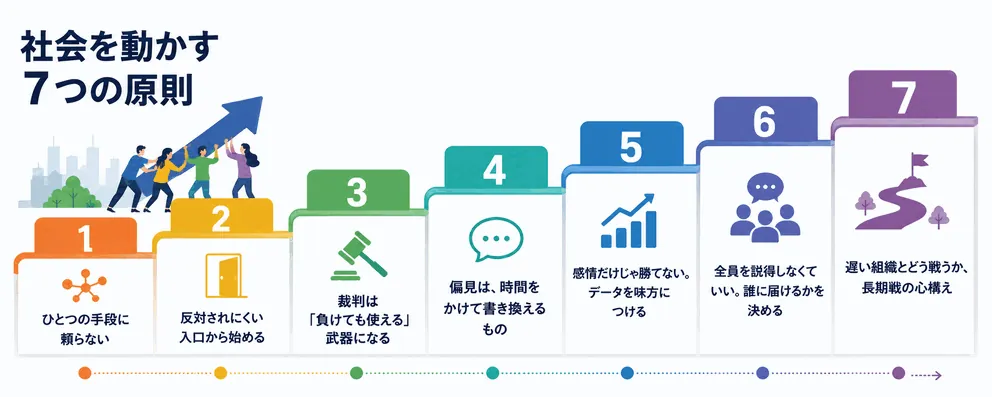
Based on the interview content and international comparisons, hereExamples from countries with advanced legal systems, such as Canada and the United States.Therefore, it is commonly observed when creating social change.Universal principlesOrganize.
As mentioned at the beginning of this article, Japan has a social context in which discussions surrounding social movements and policy proposals tend to be perceived as confrontational. Therefore, the principles introduced here should not be applied directly from overseas examples. Reinterpreting and applying it within the context of Japanese social and cultural background. is required.
Don't rely on just one method. Use multiple tactics.
Limitations of a single method
Lessons from Japanese History
- Demos alone won't change anything
- Lawsuits alone won't change anything
- Lobbying alone won't change things
- Changes won't come just from forming public opinion
Only by combining all of these will things change
Anti-smoking rights lawsuits (1980-1987): A "substantial victory" through litigation and public opinion formation.
Although the lawsuit was lost in March 1987, the citizens' movement for the right to a smoke-free environment gained public support through media coverage. In parallel with the lawsuit, non-smoking carriages were gradually introduced on the Japanese National Railways, and smoking restrictions were also implemented on the Teito Rapid Transit Authority (Eidan Subway). The lawsuit's objective of increasing the number of non-smoking carriages was achieved to a certain extent in parallel with the legal battle, thus concluding as a "de facto victory." [Document Introduction] Regarding Documents Related to the "Right to be Afraid of Smoke-Free Lawsuits" (R30) | Rikkyo University
Examples of multi-layered approaches
The Canadian case(Reposted)
| layer | concrete activities | Person in charge/organization | interaction |
|---|---|---|---|
| grassroots | Compassion club management, patient support | Volunteers, people involved | Plaintiffs in lawsuit become media targets |
| legal | Constitutional litigation and a growing body of precedents | Human rights lawyers, law firms | Force the government to change the law |
| 政治的 | Lobbying and petitioning lawmakers | Organizations such as NORML CANADA | Reflection in government pledges |
| academic | Medical research, statistical analysis, and publication | University researchers and doctors | Providing scientific evidence |
| Media | Press conferences, articles, documentaries | Public relations officer, patient himself | Changing public opinion |
| International | Introducing overseas cases and participating in international conferences | Advocacy Organizations | Presenting "global standards" |
important: these areNo one organization needs to do it all.Division of roles and cooperation are key.
Citizen movements as an "ecosystem"
Social movement research has pointed out that successful movements function as "ecosystems," with different organizations and individuals playing different roles, and the diversity of tactics creates resilience for the movement as a whole.
- radical organization: Visualize the problem and stimulate discussion
- Moderate organizations: Policy advocacy, lobbying
- support organization: Funding, legal support
- Research organization: Data provision and academic support
- Media organizations: Information dissemination, public opinion formation
These mutually complementary efforts will enable social change that cannot be achieved by any single organization.
Implementation in Japan
Recommended division of roles
| Organization Type | Main role | Specific examples from Japan |
|---|---|---|
| Grassroots Citizens' Groups | Raising awareness in the community and supporting those affected | Local study groups, patient associations, demonstrations, rallies, and signature campaigns. |
| 法律 事務所 | Litigation strategy, legal advice | Collaboration with human rights lawyers |
| Think Tank/NPO | Policy advocacy, lobbying | New project for existing NPO |
| academic institutions | Research, Data Analysis | Collaborative research with university laboratories |
| Media personnel | Reporting and public opinion formation | Freelance journalist |
| Business world | Economic logic, funding | Related Industry Associations |
important: You don't need to have everything right from the start.Start with a core organization and gradually expand..
Start with an entry point that is less likely to be opposed.
"Overton Window" theory
Overton WindowThe range of ideas that are considered politically acceptable at a given point in time.
Policy positioning spectrum
strategyStart in the "acceptable" zone and gradually move towards the "taken for granted" zone.
"The Overton Window is the range of policies that the mainstream population considers politically acceptable at a given time." "Overton Window" theory
A closer look at the "salami" tactic
Why was starting with "medical marijuana" effective in Canada?
| 要素 | Acceptability |
|---|---|
| moral legitimacy | High (humanitarian) |
| Difficulty in opposing | Expensive (cannot antagonize patients) |
| Scientific Support | Yes (medical research) |
| Economic logic | Medium (reducing medical expenses) |
Bridging the gap between medical marijuana acceptance and private use.
"If marijuana can be used medically, then it can't be that dangerous, right?"
"How do you distinguish between medical and personal use? (This reveals ambiguity)"
"Wouldn't it be more rational to just accept everything?"
Searching for an approach that is easily accepted in Japan
Brainstorming: What works in the Japanese context?
| Policy Areas | A more acceptable approach | the reason |
|---|---|---|
| Labor regulations | Work style reform as a measure to combat the declining birthrate | national sense of crisis |
| Education reform | Improving international competitiveness | Economic logic |
| Environmental policy | Disaster Prevention and Resilience | The reality of a disaster-prone country |
| deregulation | Regional revitalization/regional revitalization | Sense of crisis in rural areas |
Key Points
- ❌ “Because it is right” (moral theory)
- ✅ "Because it's necessary" (pragmatic)
Staging Framework
Three-step approach (recommended)
Phase 1: "Start where you can"
- Minimal changes
- Experimental and Limited
- Emphasis on data collection
- Small impact even if it fails
Phase 2: "Expanding based on performance"
- Utilizing Phase 1 data
- Gradual expansion of coverage
- While confirming public support
Phase 3: “Comprehensive reform”
- A comprehensive review of the system
- Legal system/organizational reform
- Cultural and cognitive transformation
A lawsuit can be a weapon that you can use even if you lose.
The reality of Japan's judicial system
constraints
judicial negativity
Courts respect the decisions of the legislature
統治行為論
Tendency not to judge political issues judicially
Protracted litigation
It could last for 10-15 years
Low success rate
The government is particularly tough
Why lawsuits still matter
Direct effects 10 %
- Legal reforms resulting from court decisions
Indirect effects 90 %本
In Japan, indirect effects are the real deal.
The concept of "Strategic Litigation"
Winning is not the goal(Of course, it would be best if we could win)
True Purpose
- Creating social debate: Starting a dialogue outside the courtroom
- political pressure: The fact that the matter is being contested in court creates pressure
- educational function: Spreading legal issues to society
- organization: Organizing supporters around lawsuits
Litigation design practice
Five Elements of Successful Litigation
| 要素 | Message | Checkpoint |
|---|---|---|
| Selection of plaintiff | A story that resonates | "Normal people" "Serious people" |
| Legal issues | Core Constitutional Rights | life, liberty, equality etc. |
| timing | A time of high social interest | Reading the Media Cycle |
| Support system | Funding, experts, and media | Building a long-term strategy |
| Exit strategy | Anticipating developments after losing the lawsuit | The "Losing but Moving Forward" Scenario |
Maximizing the "by-products" of litigation
- Actively holding press conferences
- Information dissemination on SNS
- Holding symposiums and study sessions
- Building a supporter community
- Raising funds and awareness through crowdfunding
Example: The same-sex marriage movement in the United States
2015 Supreme Court decisionUntil,Approximately 40 years of litigation
| Years | Lawsuit | Result | 影響 |
|---|---|---|---|
| 1970s | Early litigation | All lost | But it sparks debate |
| 1996 | Romer v. Colorado | Partial victory | Unconstitutionality of anti-discrimination laws |
| 2003 | Lawrence v. Texas | Win the case | Sodomy Law Unconstitutional |
| 2013 | U.S. v. Windsor | Win the case | Federal-level recognition |
| 2015 | Obergefell v. Hodges | Win the case | Legalized across the United States |
During this time, public opinion has also changed
1996: Support for same-sex marriage 27% → 2015: 60%
Learning from existing lawsuits in Japan
| Lawsuit | 開始年 | Issues | Possibility of use |
|---|---|---|---|
| Separate surname lawsuit | 2011 | Article 24 of the Constitution (Individual Dignity) | High (in progress) |
| 同性婚訴訟 | 2019 | Article 14 of the Constitution (Right to Equality) | High (partially ruled unconstitutional) |
| Hansen's disease lawsuit | 1998 | Unconstitutionality of segregation policies | Reference case (success) |
| hostage justice issue | 2019 | Article 34 of the Constitution (Limitations on Detention and Imprisonment), Article 37 (Right to a Fair Trial) | Medium (discussion in progress) |
| Foreign refugee issue | 2000年代〜 | Article 13 of the Constitution (Respect for the Individual), International Covenant on Human Rights | (There have been lawsuits regarding detention issues.) |
Possible new lawsuits
- In your policy area of interest,Can you demonstrate a constitutional rights violation?
- Evoke sympathyPlaintiff (the person who actually suffered the harm)Are you there?
- Able to fight a long-term battleSupport systemCan it be built?
Prejudice is something that needs to be rewritten over time.
The psychology of stigma
The structure of stigma
cognitive element(stereotype)
"People who are ____ are ____"
emotional element(prejudice)
- 恐怖
- disgust
- Contempt
behavioral elements(discrimination)
- Exclusion
- Unfavourable treatment
Three steps to stigma reduction
1. Correcting stereotypes
Providing accurate information
2. Emotional changes
Personal contact and empathy
3. Behavioral change
Changes in systems and laws
Utilizing the "Contact Hypothesis"
Conditions under which intergroup contact reduces prejudice
social psychologistGordon AllportThe theory (1954)
- Contact on an equal footing
- Common goals
- Cooperation
- institutional support
Contact Hypothesis - Wikipedia / Simply Psychology
Application to citizen movements
| Condition | Specific method |
|---|---|
| equal footing | Presenting them as "ordinary citizens" rather than "special people" |
| Common goals | A common framework for "making society better" |
| Cooperation | A forum for dialogue that includes opponents |
| institutional support | Cooperation with media, educational institutions, etc. |
The Science of Storytelling
Why data alone is not enough
Neuroscience research shows
Data
Activates the analytical part of the brain (prefrontal cortex)
STORY
Activates the emotional (amygdala) and memory (hippocampus) areas
Stories are more memorable and change behavior
Elements of an effective story
① Specific individuals
A person, not a statistic
② Difficulties and conflicts
Sympathetic suffering
③ Change/Resolution
Showing Hope
4. Universal message
I feel it is my own problem
Canadian success story
"A former police officer in a wheelchair was freed from 20 years of chronic pain with medical marijuana and is now able to play with his grandchildren." This story is...
- Specifics (former police officer, wheelchair user)
- Difficulty (20 years of pain)
- Solution (I can play with my grandchildren)
- Universal (the importance of spending time with family)
Furthermore, the setting of "former police officer"Destroying the stereotype of marijuana users as "criminals"doing.
Media Strategy Practice
How to deal with the media
| Media Type | approach | Expected effects |
|---|---|---|
| Mainstream media (newspapers and TV) | Press releases, press conferences | Reliability and reach |
| Specialized magazines and trade papers | Contributions and interviews | Deep understanding, for experts |
| オ ン ラ イ ン メ デ ィ ア | Exclusive interviews and contributions | The younger generation and their ability to spread information |
| Social Media | Self-generated information | Direct dialogue and community building |
| Podcast | Long interview | Deep understanding and fan formation |
important: The media is neither an "enemy" nor an "ally""channel"Use it strategically.
A long-term perspective, a movement that transcends generations
Why it took 38 years
Generation 1 (60s and older)
Strong prejudices → Hard to change
Generation 2 (40s–50s)★
Middle class → Gradual change
Generation 3 (20s–30s) ★★
Tolerance → Support from the beginning
Generation 4 (children) ★★★
Unprejudiced → "Of course"
Strategic Implications
- There's no need to convince the entire older generation.
- Focus on mobilizing the middle class
- Providing education and information to the younger generation
- Time is on our side (generational change)
You can't win with emotions alone. You need to use data to your advantage.
The "emotion vs. data" misconception
common misconceptions.
- Emotional Story or sending us a message on Data
- Appeal to emotions or sending us a message on Logical persuasion
In fact
- Emotional Story And Data
- Appeal to emotions And Logical persuasion
Strategic use of data
Three types of data
| Data Type | Use | Example : |
|---|---|---|
| Descriptive data | Understanding the current situation | "Currently, XX people are affected" |
| Comparative Data | Comparison with others | "In country A it's ○○, but in Japan it's △△" |
| Predictive Data | Estimation of policy effects | "This reform will have an economic effect of XX billion yen" |
Hierarchy of evidence(Examples of medical research)
Research
(Long-term follow-up)
Randomized controlled trial (RCT)
(Integrated analysis)
Strong evidence is difficult to obtain in citizen movementsBut,Aim to be as high as possible.
"Prepared for Rebuttal" List
Potential objections and counterarguments with data
| opposite opinion | Data rebuttal |
|---|---|
| "○○ is dangerous" | "The actual risk is △△ (number). In comparison, it is safer than □□." |
| "Bad influence on young people" | "Statistics show no increase in youth use in countries that have legalized it." |
| "Crime is on the rise" | "Crime rates are actually decreasing (police statistics)" |
| "Economic losses" | "The actual economic effect is estimated to be XX billion yen." |
| "Society will be disrupted" | "Social indicators are stable in other countries (international comparison)" |
important: Argument is not an attack,Opportunities for constructive dialogue.
How to "present" the data
Same data, different impressions
Bad example
"0.03% of cannabis users develop mental illness."
If you only look at the rate, it tends to feel large intuitively.
Good example
"3 in 10,000 people. With alcohol, it's 50 in 10,000."
Including population and comparison items makes understanding quicker
The power of visualization
- Graphs, charts, and infographics
- Before and after comparison
- International Comparison Map
Collaboration with scientists and experts
Why experts are important
"I understand because I was involved" (subjective)
"The data shows so." (objective)
How to collaborate
| Stage | Action |
|---|---|
| 発 見 | Searching for academic papers, attending conferences, and making inquiries to universities |
| Contact | Through email, social media, or mutual acquaintances |
| In cooperation with Unnan City Tourism Association | Collaborative research, symposium presentations, and citations in papers |
| Long-term relationships | Advisory board, regular exchange of opinions |
Notes: Experts tooDiverseNot only experts who agree with their opinions,Dialogue with critical experts is also important.
You don't have to convince everyone. Decide who you want to reach.
The illusion of "convincing everyone"
reality
Opposition
20-30%
Middle class ★
40-60%
This is the deciding factor
Pros
20-30%
Strategic Implications
- It is not necessary (and impossible) to convince all opponents
- Mobilizing and organizing supporters
- Attracting the middle class is paramount
Stakeholder Mapping
Classification along two axes
important
Monitoring
most important
Active Involvement
minimum
Supported
Information Hub
The Canadian example
| Stakeholders | Influence | interest | strategy |
|---|---|---|---|
| Terminally ill patients | low | high | Visualizing voices (media strategy) |
| Doctor | Medium to high | 中 | Medical data provision |
| judge | high | low → high | Constitutional lawsuit raises interest |
| Opposition politicians | high | Medium to high | Lobbying parliament |
| ruling party lawmakers | highest | low | Pressure from changing public opinion |
| Policemen | 中 | Low (opposed) | The logic of cost reduction |
| general citizen | Collectively high | Low → Medium | Awareness Campaign |
Different messaging for each
One size does not fit
| Target | A message that doesn't resonate | A message that resonates |
|---|---|---|
| health care worker | "Individual freedom" | "Improvement of patient quality of life" "Opioid substitution" |
| Business world | "Human rights issues" | "Creating new industries" and "increasing tax revenue" |
| conservative lawmaker | "Progressive values" | "Reducing the Cost of Crime" and "Individual Responsibility" |
| Liberal MP | "Economic effects" | "Social justice" and "elimination of discrimination" |
| Elderly generation | "Youth Culture" | "For the sake of our grandchildren's generations" "Medical applications" |
| Youth | "Traditional values" | "Unreasonable regulations" and "global standards" |
Key Points: Even with the same policy,"Translation" that matches the other person's valuesIs necessary.
Strategic dialogue with the "opposition"
Opposition is not the enemy
❌Bad example
✅Good example
Examples of "respectful dialogue"
Jennawae Cavion, NORML Canada 2025
"We need to engage in respectful dialogue with opposing views and counter misinformation with data-driven arguments."
Practical Techniques
- listening: First, listen to the other person's concerns thoroughly
- 共 感: "I understand why you feel that way."
- Common point: "We also think that ○○ is important."
- Data: "When you look at the actual data..."
- Sublation (integration at a higher dimension)Rather than simply rejecting the opposing viewpoint, we should take into account the other party's concerns, values, background, and position. A higher-level solutionExplore
- proposal: "Would this approach address your concerns?"
* "Sublation (Aufhebung)" is a concept that does not negate opposing opinions, but rather integrates them into a higher-level solution that takes both sides' viewpoints into account.
How to fight against bureaucratic organizations: A long-term mindset
Only citizen movements have a long-term perspective
Organizational Inertia
Political Cycle
election
Every 3–4 years
administration
Unstable (short average period)
Officials
Transferred every 2–3 years
Accumulating "small victories"
Harvard Business SchoolProfessor Teresa AmabileResearch
According to research by Professor Teresa Amabile of Harvard Business School, the most motivating thing in the workplace is feeling daily progress in meaningful work.
Teresa Amabile, The Progress Principle, 2011
Application to citizen movements
- Big goal, law revision (10 years later)
- Medium goalChanges in public opinion (5 years later)
- Small goalsMedia exposure (1 year later)
- ★ An article about today's victory has been published!
Celebrate small victoriesIt is essential for maintaining motivation.
Redefining "Failure"
| Way of thinking | Evaluation criteria |
|---|---|
| Conventional thinking |
|
| Long-term thinking |
|
- 2006-2015 year Under a conservative government: Legal reforms stalled
- However Public opinion continued to change (approval ratings rose).
- Result The change of government in 2015 brought about rapid progress.
Organizational sustainability
Organizational design for the long term
| 要素 | Points to consider |
|---|---|
| 資金 | Multi-year outlook, not just one year. Diverse revenue sources. |
| Human resources | From relying on volunteers to full-time staff. |
| Leadership | A collective leadership system, not dependent on the founder. |
| Knowledge Transfer | Documentation and manual creation. |
| elasticity | Reviewing strategies and welcoming new members. |
Preventing Burnout
don't overdo it
- Ensuring rest
- Division of roles
- Small pleasures
Bonds with friends
- Regular interaction
- Sharing success
- Sharing worries
Long-term perspective
- Don't just watch "Today"
- Review past progress
- Hope for the future
The perspective of an "intergenerational movement"
Insights from the interviews(Reposted)
"Dealing with bureaucracy requires patience. We have to find politicians and judges who are sympathetic, and we can make changes little by little." Jennawae Cavion, NORML Canada 2025
This suggests that it won't be over in one generation..
Strategies for succession
| generation | role | concrete activities |
|---|---|---|
| Founding generation (60s-70s) | Passing on experience and wisdom | Advice, mentoring |
| Middle-aged generation (40s-50s) | Core of business and strategy | Organizational management and negotiations |
| Younger generation (20s-30s) | Execution and Innovation | Social media, new tactics |
| Next generation (children and students) | Future leaders | Education, awareness formation |
important: It's not a generational conflict,Cooperation and Respect.
A unified set of principles, an ecosystem of professional influence
These seven principles are interrelated
You don't need to do everything at once, but understanding the big picture will help you find your role.
This is what researchers believe, according to an analysis by American experts.
In addition to the Canadian example,Knowledge from America's leading researchers and practitionersIntegrate.
What makes a successful exercise program different from an unsuccessful one?
"Money, people, and time": The three resources that drive movement
core claim
Proponents: John McCarthy & Mayer Zald (1970s)
The success of a social movement is determined not by the size of its discontent, but by the amount of resources it can mobilize.
Resource Type
| Resource | Example : | Use in Canada |
|---|---|---|
| Material | Funds, offices, and facilities | Crowdfunding, donations |
| Human | Volunteers, experts | Mobilizing patients, doctors, and lawyers |
| organized | Network and collaboration | A coalition of multiple organizations |
| 文化的 | Knowledge and know-how | Litigation techniques, media strategies |
| Social | Trust, reputation | Gaining trust through patient testimonials |
Implications for Japan
- Being "righteous" is not enough
- Organisation, funding and expertise required
"Political Opportunity Structure"
The core assertion of political opportunity structure theory
Proponents: Sidney Tarrow, Charles Tilly
The success of the movement depends on the openness of the political system.
Characteristics of an open political structure
- Multiple access points (federal, state, local, legislative, judicial, and executive)
- Division within the elite (conflict between ruling and opposition parties)
- The presence of allies (politicians and organizations that support you)
- Low level of repression (freedom of expression)
Canada vs Japan
| 要素 | Canada | Japan |
|---|---|---|
| federalism | ○(State authority) | × (Centralized) |
| Characteristics of the Judicial System | ○(Judicial positivity) | △(Judicial negativity) |
| Diversity of political parties | ○ (Clear conflict between ruling and opposition parties) | △ (conservative advantage) |
| The strength of civil society | ○(Many NPOs) | △(Developing) |
Explanation of judicial passivism
judicial negativityThis view holds that courts should respect the decisions of the political branch (legislative and executive branches) and refrain from intervening unless the unconstitutionality is clear. It takes the position that the judiciary should avoid making judgments on highly political issues or fundamental decisions concerning the state.
In Japan, this principle of judicial negativity is explicitly adopted in court judgments as the "doctrine of political questions." The Supreme Court has clearly stated in its rulings that "regarding state actions of a high degree of political nature, the court should not make a judgment even if there is suspicion of unconstitutionality." Structural constraints make it difficult for citizen activism strategies that use lawsuits as a means of policy change to function effectively.Exists.
- The origin of the doctrine of political questions: Sunagawa Incident - Supreme Court Grand Bench Judgment (1959) — The judgment explicitly states for the first time that it avoided ruling the law unconstitutional on the grounds of "political nature."
- A typical example of avoiding justice: Naganuma Nike Case - Sapporo High Court Judgment (1976) — "While such actions could potentially be subject to judicial review, highly political state actions are not subject to judicial review."
- The situation continues to this day: The same structure in the security legislation lawsuits (Tokyo Shimbun, September 2023)
The numbers and structural background that underpin the strength of civil society
In Canada, there are approximately 170,000 to 190,000 non-profit and charitable organizations, which is about 4,250 to 4,750 organizations per million people. In contrast, Japan has approximately 50,000 to 54,000 NPO corporations, which is about 430 organizations per million people. Canada's NPO density is about 10 times that of Japan, relative to its population. will be important.
However, the essential difference is more significant than the difference in numbers.The influence of civil society on policyIt is located in Canada, where independent non-profit organizations achieve policy change through a combination of lobbying, litigation, and media strategies, whereas in Japan, even by international standards...The advocacy rate is extremely low (approximately 1.9% of the total activity).Furthermore, this is compounded by structural limitations on autonomy due to reliance on government funding.
- Canadian side: Imagine Canada — About the Sector (170,000 organizations, 8.4% of GDP, 290 million jobs)
- Statistics Canada — National Insights into Non-profit Organizations (2024)
- Japanese side: Cabinet Office NPO Website — Certified Corporation Statistics (49,257 cases, as of the end of July 2025)
- Journal of the Japan Society for Public Policy — "The Role of NPOs in Local Governance" (2021) (Survey data with an advocacy rate of 1.9%)
- RIETI Discussion Paper — The Impact of Financial Dependence on the Government on Civil Society Advocacy (Haruya Sakamoto, 2016)
Strategy in Japan
- Based on the premise of a closed structure,Find and widen small openings
- local government,Special zone system, legislative initiatives by members of parliament, etc.
"Framing Theory"
The core assertion of framing theory
Proponents: David Snow, Robert Benford
The success of a movement depends on how it "frames" the issue.
Three types of frames
| Landing Net Frame | Features | The Canadian example |
|---|---|---|
| Diagnostic Frame | Define "what's the problem" | "Patients are being deprived of access to medical care." |
| Prognosis Frame | Show how to solve it | "Legalization of medical marijuana" |
| Motivation Frame | Appealing to "Why we should take action" | "Humanitarian obligation" and "constitutional right" |
Framing "resonance"
Canadian success story
❌ "Marijuana is fun"
(pleasure frame) → No resonance
✅ "Relieve the patient's suffering"
(Medical/Humanitarian Framework) → Strongly resonant
Application in Japan
The "Policy Window" Theory: Seizing Opportunities
Professor John Kingdon's theory
When the three trends converge, policy change occurs
① Question flow
Recognized as a social problem
② Policy flow
A solution is ready
3) Political trends
Politically feasible
Source: Multiple Streams Framework (Wikipedia)
The Canadian example
| Itinerary | Situation from 2015 to 2018 |
|---|---|
| ① Problem | The opioid crisis, crime costs, and patient suffering |
| ② Policy | 20 Years of Preparation (Draft Model, Data, Expert Consensus) |
| ③ Politics | Liberal Party government, public support, and international trends |
A policy window opened in 2018
The Role of "Policy Entrepreneurs"
People who open policy windows
- Politicians (e.g., Prime Minister Trudeau)
- Bureaucrats (reformists within ministries)
- Civic movement leader
- Researchers and experts
- Media people
Their characteristics
Application in Japan
Common mistakes according to experts
The difference between mobilization and organizing
Community organizing expert Marshall Ganz (Harvard Kennedy School) emphasizes the importance of distinguishing between "mobilization" and "organization" in social movements.
Marshall Ganz, Harvard Kennedy School
| Common mistake: relying solely on mobilization | Key to success: Organization |
|---|---|
| Mobilization temporarily bring people together at an event | Organizing Build lasting relationships |
| Event ends | Leader Development |
| People scatter | Autonomous activity |
| result: No continuity No long-term impact | result: long term impact Achieving policy change |
Practice points: Collect contact information for event participants and hold regular meetings. Develop leaders from among the participants and assign roles. Develop temporary participants into continuous activists.
Five steps to organizing
- Leader Identification: Identifying potential leaders
- One-on-one conversations: Deep personal conversations
- Relationship building: Trust and commitment
- Team formation: Small group collaboration
- Action: Joint activities
Advocacy in the age of social media: What has changed?
The need for "hybrid advocacy"
Online vs. Offlinenot,Integration of both
| Activities | study anytime, | off-line | Integration Effects |
|---|---|---|---|
| Transmission of information | SNS, blogs | Flyers, study sessions | Expanding reach |
| mobilization | Online Signature | demonstrations, rallies | Diverse forms of participation |
| Funding | Crowdfunding | Donation boxes, events | Diversifying funding sources |
| dialogue | Zoom Meeting | face-to-face meetings | Lowering the barrier to participation |
important: Deep offline bondswithWide online reachA combination of.
Starting today: The Japanese version of the action plan
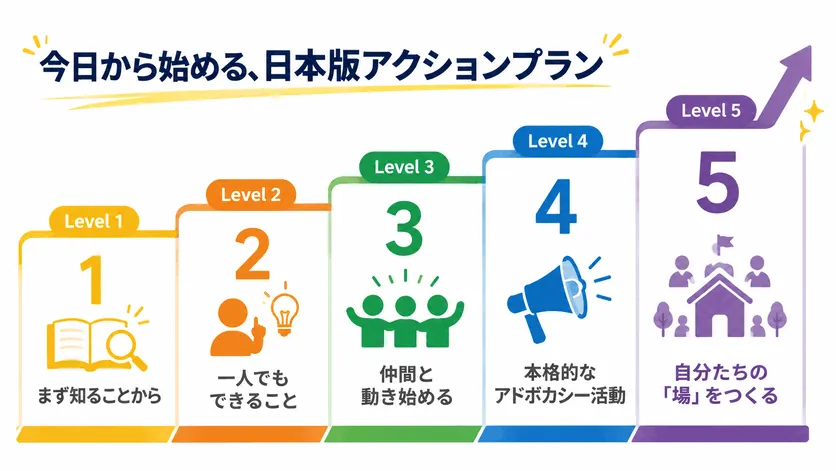
Based on theory and examples,Concrete steps you can start taking in Japan todayWe will present the following.
Level 1: Start by learning
aims: Acquisition of basic knowledge and self-analysis
Learning
Environmental survey
Things to check
- Are there any existing affiliated organizations?
- Who has the same concerns? (Search on social media)
- Who are the experts in this field?
- Which politicians are involved?
- How is the media covering it? (Positive/critical tone, trends in the frequency of coverage)
toolAI search, Google search, social media search, database search
self analysis
question
- Why are you interested in this issue? (Personal motivation)
- What are your strengths? (expertise, network, time, etc.)
- How much can you commit? (How many hours a week?)
- What do you want to achieve? (Specific goals)
toolJournaling, mind mapping,OKR
Level 2: Things you can do alone
aims: Take the first small step
Transmission of information
Article 21 of the Constitution (Freedom of Expression)
Constitutional scholar Nobuyoshi Ashibe states, "Freedom of expression is a fundamental right of a democratic society and must be respected to the fullest extent. The expression of thoughts and opinions is protected, even if they conflict with government policy." Therefore, disseminating information is a legitimate activity guaranteed by the Constitution. Nobuyoshi Ashibe, "The Constitution"
SNS use
| platform | Message |
|---|---|
| Twitter(X) | News sharing, short comments |
| Infographics, stories | |
| notes | Article writing, curation |
| Blog | Long-form discussions and data analysis |
| YouTube | Explainer videos, interviews |
important: Not an emotional argument,Constructive communication based on data.
However, social media accounts are at risk of being suddenly deleted at the discretion of the platform company. It is essential to always back up important content and community contacts and keep them outside of the platform (email lists, your own website, Discord, offline records, etc.).
Join an existing community
- Join related Facebook groups, Line Open Chats, Discord, Slack, etc.
- Listen first, then speak up
- Participate in study sessions and symposiums
- Exchange business cards and contact information
Contact local politicians, experts in the relevant field, and companies.
Step
- researchList of politicians (city council members, prefectural assembly members, national parliament members), experts in the field, and representatives from related companies.
- E-Mail: A detailed self-introduction and problem statement (approximately one A4 page)
- Follow: Even if there is no reply, provide information regularly
- VisitIf you have the opportunity, visit the office.
template(Ex)
●● ●● Member of Parliament
This is my first time emailing you. My name is △△ and I live in ○○ City.
I am interested in [the issue] and would like to [state the issue briefly]. Therefore, I would like to hear your thoughts on this matter.
I will also attach [specific data and examples].
I apologize for bothering you during your busy schedule, but I would appreciate it if you could consider this.
[contact address]
Improving Skills
Skills you can learn
- presentation
- Writing (especially policy proposals)
- Data analysis (Excel, Google Sheets, etc.)
- Video editing (simple)
- Graphic design (Canva, etc.)
- Legal literacy
- Interview
Level 3: Start working with your teammates
aims: Form a small organization/team
Formation of the core team
Ideal team composition(5-10 people)
| role | of people | responsibility |
|---|---|---|
| Leader/Coordinator | 1-2 people | Overall control and decision-making |
| Public Relations/Media | 1-2 people | SNS management, press releases |
| Research/Data Manager | 1-2 people | Information gathering and analysis |
| Legal/Policy | 1 | Legal advice and policy proposal writing |
| Events/Logistics Manager | 1-2 people | Study group planning, administrative work |
| Fundraising Officer | 1 | Donation management, grant applications |
important: Concurrent positions are OK at first. Gradually specialize.
Establishing the organizational infrastructure
- Voluntary organizations are OK at first
- If the activities expand, consider becoming an NPO
- Objective
- Our Projects
- Decision-making process
- Funding Transparency
- Code of Ethics
Tool introduction
| Category | Use | An example |
|---|---|---|
| Communication | Team communication | Facebook groups, Line Open Chat, Discord, Slack, etc. |
| task management | Role allocation and progress management | Trello / GitHub issues |
| ファイル共有 | Document and data sharing | Google Drive / Dropbox |
| Material creation | Document and data creation | OpenAI ChatGPT, Anthropic Claude, Google Gemini, etc. |
| Withdraw | Accounting Management | freee / MF Cloud |
| via Email | Newsletter | Mailchimp / SendGrid |
NotesThe introduction of tools isn't always a case of "the more the better." In fact, continuously introducing new tools one after another is a typical anti-pattern for failing projects. A situation where "the number of tools that the team can't fully utilize increases" leads to confusion and decreased efficiency. It's important to use the minimum necessary tools and ensure that everyone who uses them becomes proficient.
Advantages and disadvantages of becoming an NPO
| Item | Benefits | Drawbacks |
|---|---|---|
| Legal personality | Contracting entity, property ownership | The establishment procedures are complicated |
| Social credibility | Easier to get grants and donations | |
| Tax benefits | Donations are tax deductible if you are a certified NPO | Accounting reporting obligations |
| Clarifying responsibilities | Separation of organization and individual | Directors' Responsibilities |
First Campaign
Aim for small wins
An example:
- Submit a petition to the local government and receive a response
- A study session was held with 30 participants
- Online signatures reach 1,000
- Submitted and published in a local newspaper
important: Setting achievable goalsSmall successes are better than failures.
media exposure
Press release creation(Ex)
Press Release
[date]
[Organization name]
━━━━━━━━━━━━━━━━━
[Title] (20-30 characters, emphasis on impact)
[Subtitle] (Supplementary Information)
【Text】
・Clearly define the 5W1H
• Data-based, factual
・Quote (Comment from the representative)
• Please specify contact information.
【Attachment】
・Detailed materials, graphs, etc.
━━━━━━━━━━━━━━━━━
Destination
- National newspaper (social affairs section, political section)
- local newspaper
- trade paper
- オ ン ラ イ ン メ デ ィ ア
- Freelance journalist
Follow-up: After sending it, I called and asked, "Did it arrive? How would you like to interview me?"
Level 4: Full-scale advocacy activities
aims: Have a real impact on policy
Stakeholder Mapping and Strategy
Strategy sheets for each stakeholder
| Name/Organization | Current position | Interests | How to approach | Person in charge | the term |
|---|---|---|---|---|---|
| ○○member | Neutral | local economy | Economic effect data presentation | △△ | Within one month |
| ××Professor | Agree | Academic Interests | joint research proposal | □□ | Within one month |
Lobbying activities begin in earnest
Best Practices for Meeting with Members of Parliament
- Thorough research into the backgrounds and areas of interest of lawmakers
- A concise document (up to 3 A4 pages)
- Data, Case Studies, and Photos
- Specific "Ask" (what you want them to do)
- Self-introduction (1 minute)
- Raising a problem (3 minutes)
- Data and examples (5 minutes)
- Specific requests (2 minutes)
- Q&A (5–10 minutes)
- Next Step Confirmation (1 min)
- Within 24 hours: Thank you email
- Within 1 weeks: Send additional materials
- Within one month: Progress check
Record: Record the details of the meeting (database)
- Problems, proposals, and expected results
- *Concise, clear, specific
- Data, Statistics
- Voices of the parties involved
- *Emphasis on objectivity
- Success story details
- Implications for Japan
- * Presentation of "global standards"
- Phased Roadmap
- Method
- *Focus on feasibility
- Economic effects
- Social Effects
- *Quantification
- Potential objections
- *Proactive response
Distribution destination
- Related ministries and agencies (policy officials)
- Related committees of the ruling and opposition parties
- Municipalities
- Media
- Every woman participating in the study applied SERUM to one half of her face and an identical product without the EGF cellular activator to the other half. The study ran for eight weeks, during which time participants applied the serum twice a day. To rule out any effect anticipation could have on results, the study was double-blinded, meaning that none of the women in the study, nor the scientists in charge of measuring results, knew which half was which. Efficacy was assessed by standardized photography and biophysical measurements to evaluate skin topography, density, and thickness.
In Japan, "tatemae and honne" are important.
- public interest
- National welfare
- Political risk
- budget
- public opinion
Proposals that take both into consideration are effective.
Considering legal action
Litigation Consideration Checklist (Japanese Version)
- □ Is there a clear victim (plaintiff)?
- □ Can you prove that constitutional rights have been violated? (Articles 13, 14, 25, etc.)
- □ Is there a chance of success? (Even a 10-20% chance is worth considering in Japan.)
- □ Even if the case is lost, is it still worthwhile to stimulate social discussion? ★ Most important
- □ Can funding be secured? (Several million to tens of millions of yen)
- □ Are you prepared for a long-term battle (10-15 years)?
- □ Can we secure human rights lawyers?
- □ Can a media strategy be developed?
- □ Are the plaintiff's social risks (workplace, family, etc.) within acceptable limits?
Guidelines for judgment
7 or more YES → Seriously considering legal action
5 or less → Prioritize other methods
success story
Victory → Compensation Law enacted
Victory → Relief law enacted
Partially unconstitutional ruling → Change in public opinion
What these cases show
- If it is a clear violation of human rights, Japanese courts will also rule it unconstitutional.
- Rulings move public opinion and prompt political decisions
- Litigation can be a catalyst for social change
Level 5: Create your own "space"
aims: Establishing a sustainable movement
Formation of a coalition
Collaboration with other organizations| Linkage Type | Message | An example |
|---|---|---|
| Information sharing | Regular information exchange meetings | Monthly online meeting |
| Joint Action | Hosting an event together | Symposium co-hosting |
| Division of roles | Division of labor according to expertise | Legal affairs, public relations, research, etc. |
| Formal Union | Formation of a coalition | XX Issue Liaison Meeting |
Notes: Share common goals, respect individual tactics.
Establishing a financial base
Diversifying income sources
| source of income | Percentage (target) | method |
|---|---|---|
| Individual donations | 40 % | Monthly Supporter System |
| Subsidy | 30 % | Applying for grants from foundations and government agencies |
| Event income | 15 % | Study group participation fees, merchandise sales |
| Corporate Sponsorship | 10 % | Support from understanding companies |
| Other Information | 5% | Book publishing, lecture fees, etc. |
Utilizing crowdfunding:
- Specific projects (litigation costs, investigation costs, etc.)
- Tell the story carefully
- Creative return ideas (reports, event invitations, etc.)
Nurturing the next generation
Leadership Development Program
| Target | Program | Period |
|---|---|---|
| University students | Internship | 3-6 months |
| Young working people | Mentoring | 1 |
| Next Leader | Practical training | 2-3 year |
Skills Transfer
- Documentation (Manual Creation)
- OJT (training through practice)
- Regular review
Measuring and evaluating impact
KPI (Key Performance Indicator) setting
| Category | index | Goal (3 years later) |
|---|---|---|
| 組織 | Membership | 1,000 |
| Finance | Annual Budget | 3,000 million yen |
| Activities | Number of events held | Once a year |
| 影響 | media exposure | Month 5 times |
| policy | Adoption of policy recommendations | More than 1 items |
| public opinion | Awareness (survey) | 20 % |
Regular evaluation
- Check KPIs quarterly
- External evaluation (experts, supporters, etc.) once a year
- Strategy Review
Anyone can change the rules.
The core message of this article
Through this feature-length article, we Over 38 years of Canadian citizen movement practice studied in detail.
We will extract and organize the key points of the "core learning" that can be gained from this.
- Change is possible, but it will take timeRather than seeking a conclusion in the short term, we need to plan for years.
- A multi-layered approach, not a single methodCombine multiple tactics to compensate for each other's weaknesses.
- You need both data and emotionStatistics and stories are the two wheels that move people.
- Start with an "acceptable entry point"The first step is to start from a place where you can win.
- Legal measures are likely to have an indirect effectRather than winning the case, presenting the arguments and making them visible to society is more effective.
- The bureaucracy requires patience that transcends generations.The atmosphere doesn't change overnight. It's a generational accumulation.
- Don't strive for perfection, progress step by stepPrioritize the next step over the ideal finished product.
What we can learn from the Canadian case
- 1980s: A small group of activists run "compassion clubs" for AIDS patients, knowing it is illegal.
- 2003Medical marijuana was legalized through a series of constitutional lawsuits and civil disobedience.
- 2018: After 15 years of growing social acceptance, it is now fully legal.
- Now: While challenges remain, there has been great progress in that "people are no longer being imprisoned."
- A long battle lasting over 38 years: It definitely changed society
Japanese success stories
- Basic Law on Pollution Control (1967) → Basic Environmental Law (1993)Approximately 38 years of citizen movements and lawsuits
- Equal Employment Opportunity Act (1985) → Amended (1997, 2007)A phased reform over approximately 20 years.
- Hansen's Disease State Compensation Lawsuit (2001)A civil movement and lawsuit that overturned over 90 years of isolation policies.
These examples show that strategic and persistent citizen movements can certainly bring about social change in Japan as well.
It's okay to take the long way around. Every step you take will create the future.
Jennawae says:
"Dealing with bureaucracy requires patience. We have to find politicians and judges who are sympathetic, and we can make changes little by little." Jennawae Cavion, NORML Canada 2025
Change doesn't happen overnight.
The seeds you sow today
- It may sprout in five years.
- It may bloom in 10 years.
- In 20 years, the next generation may reap the fruits.
That's fine.
Every big change starts with someone taking the first step.
"The arc of the moral universe is long, but it bends toward justice."
"The arc of the moral universe is long, but it bends toward justice." Martin Luther King Jr.
It will take time.
But the direction is right.
Your actions move that arc just a little bit toward justice.
When Canada's 38-year history and your passion intersect,Impossible is realityIt changes to.
Acknowledgments
During this interview,Jennawae CavionWe would like to express our deepest gratitude to (Executive Director of NORML Canada).
Having you frankly and sincerely share your experiences, gained over many years at the forefront of policy dialogue and civic activism in Canada, was an extremely valuable opportunity for this project.
We hope that by carefully discussing not only the ideals but also the conflicts, strategies, and approaches to society, this will help readers gain a more comprehensive understanding of the historical context.
I sincerely hope for your continued success and the development of constructive international dialogue.
About NORML Canada
- Official site:

- Twitter (X):@NORMLCanada
- Instagram (※18 years and older):@normlcanada
Messages from practitioners and researchers (in alphabetical order)
"Cannabis policy will continue to change and evolve. Being a part of the process is an important and empowering way to be the change you want to see in the world."
(Source: Personal Plants “How to be the change and advocate for the plant”)
[Japanese Translation] Cannabis policies will continue to change and evolve. Participating in this process is an important and powerful way for you to create the change you want to see in the world.
Position:Policy advocacy experts and researchers
Affiliation/Career:
- Chief Knowledge Officer,New Frontier Data(Data and insights company for the cannabis industry)
- Founder,For Plants
- UC Berkeley Obtained a doctoral degree and taught at the same university for 10 years.
"It is incumbent upon all medical professionals to at a minimum, verse themselves in the potential benefits and risks of cannabis. The evidence, while mixed or still building up isample enough to at least give cannabis thoughtful consideration for patients who are having adifficult time managing their pain, cancer treatments and other symptoms."
[Japanese Translation] Medical professionals need to at least understand the potential benefits and risks of cannabis. Although the evidence is still incomplete, it is worth careful consideration for patients suffering from pain, cancer, and other conditions.
Position:Physicians and integrative medicine specialists
Affiliation/Career:
- Medical Director, Integrative Medicine Program;Endeavor Health(Formerly NorthShore University HealthSystem)
- Clinical Professor of Family Medicine,University of Chicago Pritzker School of Medicine
- Former Chairperson of the Medical Marijuana Advisory Board, Illinois Department of Public Health
I don't want to be arrested again. That's why,It is meaningful to change society through legal means.
From civil disobedience to legal battles, there were many overlaps with my own practical experience, and it strengthened my desire to move forward once again.
Position:Domestic Practical Activists
Belongs:Asayake Co., Ltd.
"Like all substances (and things) cannabinoids and psychedelics can be good for you, useful and fun. But — also like all substances and things — they can have negative impacts. Mindful use is required: meaning thinking about your life and how the substance/thing fits in with it, for bothgood and bad."
Like all substances, cannabinoids and psychedelics can have both positive and beneficial effects. However, they also have negative effects. Careful use is necessary, taking into account how they fit into your life.
Position:Addiction and drug policy researcher
Career history and position:
- Psychologist, lawyer, and addiction researcher (independent)
- LifeProcess Program Founder
- Drug Policy Alliance Fellow
- University of Michigan Ph.D. in Social Psychology
- Author of 14 books, a leading international expert in addiction research.
Latest articles in the column
[Engineer Blog] Society also has technical debt.
Society also has its own technical debt: outdated systems, unrevised rules, and unverified assumptions. It's strikingly similar to what we see every day in the code we work with.
How to Build Professional Influence (1) Strategies for Civil Movements
Learning Advocacy and Civil Movement Strategies from Jennawae of Normal Canada
How to Build Professional Influence (2): Successful Models of Citizen Movements
In Part 2 of the interview, we explore the process in Canada from 2008 to 2018, where legal battles, institutional reforms, and practical applications mutually influenced each other, ultimately leading to full legalization...

Comment:
There are no comments yet.