
Article Text
Please comply with the laws and regulations of the country in question regarding the possession and use of drugs.
Drug analysis of the designer drugs seized in the Ikebukuro car crash incident is progressing, and it appears that two types of synthetic cannabinoids have been identified. Both are said to be new types of drugs that are not covered by the recent regulations that came into effect yesterday. It is unclear whether the analysis results have been released after all tests have been completed, or whether this is just an announcement of the outlook while the process is still underway, but given the difficulties in identifying unregulated drugs, it seems to be progressing at a faster pace than expected.
table of contents
Ikebukuro rampage incident: new type of synthetic cannabinoid found in illegal drug
In the incident where a car went out of control near JR Ikebukuro Station, killing and injuring eight people, it has been revealed through interviews with the Tokyo Metropolitan Police Department's Traffic Investigation Division by July 11th that plant fragments found inside the car have hallucinogenic effects similar to those of marijuana. These fragments are classified as "legal highs" and are not designated drugs prohibited from sale, possession, or use under the Pharmaceutical Affairs Law. According to the Traffic Investigation Division, the two components detected were "5F-AMB" and "AB-CHMINACA." Both are synthetic cannabinoids, known to cause hallucinations and auditory hallucinations similar to those of marijuana and are addictive. The driver, Keiji Nagura (37), who has been referred to prosecutors on suspicion of violating the Act on Punishment of Offenses Relating to Driving (dangerous driving resulting in death or injury), has confessed to purchasing a bag of herbs for 5000 yen at a store near the scene. The division will further analyze the components to investigate their impact on the driving. (Nihon Keizai Shimbun, July 11, 2014, 13:46)
Attorney Komori Sakae's Notes on Drug IssuesUpon investigating using the reported aliases as a clue, it turns out these two substances are remarkably similar types of drugs. Recently, there's been an increase in cases where multiple drugs are combined in designer drugs, but if two such similar substances are used together, wouldn't the combined effect further enhance their effects? Once the detailed analysis is available and expert commentary is provided, we'll be able to gain a more concrete understanding of the dangers posed by designer drugs. Let's look forward to future information.
●The reality of designer drugs that remain on the market while constantly changing their details. After doing some research on my own, I was able to gain a slightly better understanding of the reality of designer drugs that survive by constantly changing their details and defying regulations.
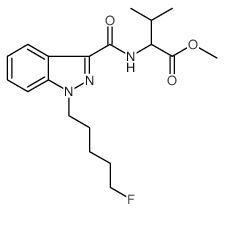
■5F-AMB
This is an analog of AB-PINACA, which was designated as a controlled substance in April 2013. In Japan, AB-PINACA began circulating as a designer drug around the summer of 2012. After it was regulated, ADB-PINACA and 5F-AB-PINACA, which have very similar chemical structures, appeared on the market as substitutes. However, in June of this year, both were designated as controlled substances, and the regulations came into effect on July 11th. The detection of 5F-AMB in the circulating product this time indicates that manufacturers had already switched to the new substance in preparation for the regulation of the earlier ADB-PINACA and 5F-AB-PINACA. While reliable data on the effects and dangers of 5F-AMB cannot be found, given that AB-PINACA, which has a very similar chemical structure, has been reported to show affinity for the CB1 receptor comparable to that of JWH-122 (February 15, 2013, Minutes of the Designated Subcommittee Meeting of the Pharmaceutical Affairs and Food Sanitation Council), it is thought to be a fairly potent drug.
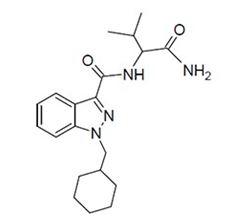
■AB-CHMINACA
This is an analog of AB-FUBINACA, which became a designated drug in December 2012. The original AB-FUBINACA was originally developed by Pfizer as a CB1 receptor agonist, but recently it has begun to be used as a component of designer drugs. In Japan, AB-FUBINACA began circulating as a component of designer drugs around the second half of 2012, and was designated as a designated drug in December of the same year. Subsequently, ADB-FUBINACA, which has a very similar chemical structure, appeared on the market, and this was designated as a designated drug in the spring of 2013. It is unclear when the AB-CHMINACA detected this time began circulating, but it is currently on the market as a component that is not subject to the regulations that came into effect on July 11th. While reliable data on the effects and dangers of AB-CHMINACA cannot be found, AB-FUBINACA, which has a very similar chemical structure, has been reported to have approximately 46 times the affinity of Δ9-THC according to calculations based on tests. Furthermore, ADB-FUBINACA, which appeared later, is said to have approximately 114 times the affinity of Δ9-THC (Minutes of the Designated Drugs Subcommittee Meeting of the Pharmaceutical Affairs and Food Sanitation Council, October 16, 2012 and February 15, 2013). Therefore, it is thought that AB-CHMINACA has a similarly strong effect.
■ Rapid change in response to regulations
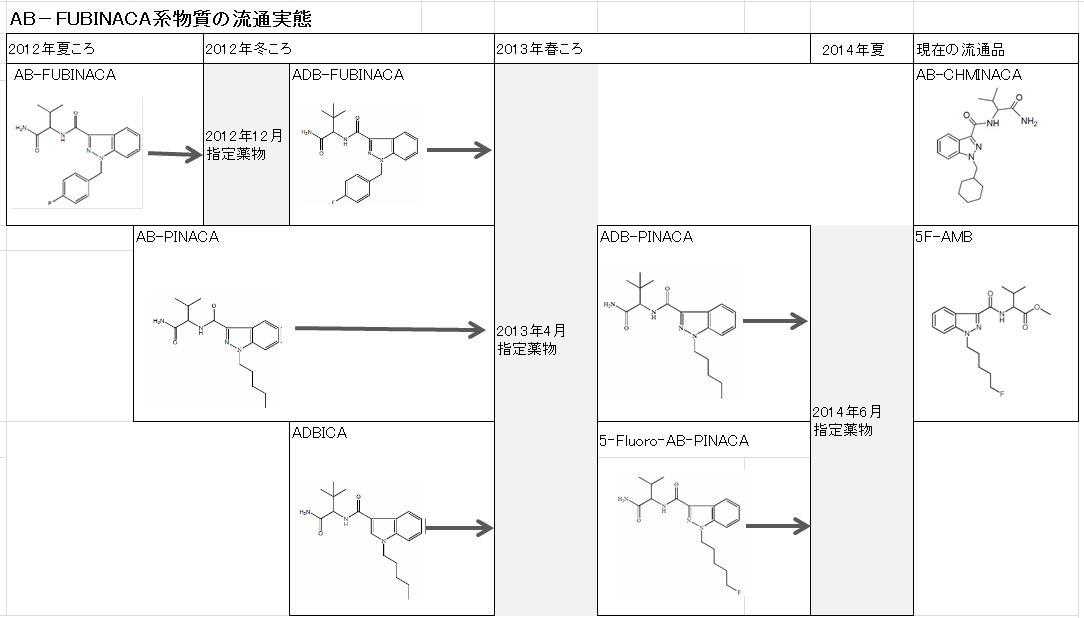
Around 2012, when the market for designer drugs was rapidly expanding in Japan, new synthetic cannabinoids were appearing one after another, and one of them was AB-FUBINACA. As mentioned earlier, this was a synthetic cannabinoid developed by Pfizer but never put into practical use. After the designer drug boom, past scientific literature was unearthed and it was repurposed as a component of designer drugs. However, once it began to be used in the designer drug market, analogues with subtle changes in its chemical structure were quickly created specifically for designer drugs and began to circulate one after another. Let's tentatively call this group of substances "AB-FUBINACA-type substances." The diagram below was created by looking back at the records of regulations to understand the AB-FUBINACA-type substances that appeared in the designer drug market in Japan. Since AB-FUBINACA was first identified around the summer of 2012, six analog substances with very similar chemical structures have appeared on the market and have already been regulated in the two years since then. However, 5F-AMB and AB-CHMINACA are still in circulation. Incidentally, I am a complete novice when it comes to chemistry and cannot write structural formulas, so the structural formulas of 5F-AMB and AB-CHMINACA used here are ones I found on the internet. The notation is different from others, so the similarity may not be obvious, but if you look closely, you will see that their structures are very similar.
↑The actual distribution status of AB-FUBINACA substances (created by Sakae Komori)
Incidentally, the first report of AB-FUBINACA, the source of a group of substances, being found in designer drug products came from Japanese researchers. The same is true for AB-PINACA. Recently, the speed at which regulations are introduced in Japan has been remarkable, and we are now able to regulate new types of drugs that appear on the designer drug market ahead of other countries. This is a major step forward in combating designer drugs.
However, the reality is that in response to the rapid introduction of regulations, the manufacturers of designer drugs are also responding more quickly. By switching to new ingredients in preparation for the regulations and launching new products one after another, the cat-and-mouse game has only intensified. As a result, the Japanese designer drug market now seems to have become one of the places in the world where the newest types of drugs make their debut.
This has given rise to new challenges. There is increasingly little information available anywhere in the world about the drugs used in currently distributed products. When serious incidents or drug-related accidents occur due to designer drugs, the lack of information about the causative drug, or the difficulty in identifying it, becomes a major challenge. In the recent Ikebukuro car crash, the identification of the causative drug is progressing faster than expected, which is undoubtedly due to the tireless efforts of the entire forensic science laboratory. The efforts of those involved are truly commendable.
Recommended products
CBD (Cannabidiol) VAPE Liquid
Taking a deep breath, you feel as if you have stepped into a coniferous forest.
Tax included ¥5,720
View product details
CBD (Cannabidiol) Menthol Vape Liquid
Ice Breath, Silent Gravity
Tax included ¥6,050
View product detailsAfter you understand, take a look at related products.
You can easily find a list of products similar to the themes featured in the article. Use this to compare products and check their details.
Drug analysis of the designer drugs seized in the Ikebukuro car crash incident is progressing, and it appears that two types of synthetic cannabinoids have been identified. Both are said to be new types of drugs that are not covered by the recent regulations that came into effect yesterday. It is unclear whether the analysis results have been released after all tests have been completed, or whether this is just an announcement of the outlook while the process is still underway, but given the difficulties in identifying unregulated drugs, it seems to be progressing at a faster pace than expected.
Latest articles on laws, regulations, and administration
Submission of public comments regarding the "Act to partially amend the Cannabis Control Act and the Narcotics and Psychotropic Substances Control Act"
This e-liquid online shop submitted the following opinion to the public comment procedure (public comment) conducted by the Pharmaceutical Affairs Bureau, Ministry of Health, Labour and Welfare, regarding the "Act to Amend Part of the Cannabis Control Act and the Narcotics and Psychotropic Substances Control Act"...
Lawyers at the forefront of drug cases and redress for wrongful convictions
Drug offenses are serious criminal cases that can completely change one's life once arrested. However, in reality, there are many cases of wrongful conviction (social wrongful conviction) where innocent people are mistakenly arrested, including cases where the person is not indicted. In these cases...
The suicide of a Shibuya dispensary owner and Japan's justice system
On February 18, 2025, GRAY, the manager of a dispensary shop in Shibuya, committed suicide by jumping from a building. My relationship with him was limited to exchanging brief greetings in 2023 and 2024, but I learned of this incident...

Comment:
There are no comments yet.