table of contents
In-depth commentary on medical, business, and social issues | April 2026
You might think this sounds like a conspiracy theory. However, this is a real incident that happened just last week, involving real names, real amounts of money, and real companies.
Drugs once abused in nightclubs are now transforming into cutting-edge psychiatric treatments. This book explores their 100-year history, the strategic ambitions of Japan's largest pharmaceutical company, and the mental health crisis that Japanese society is failing to confront.
Introduction: The "Historic Announcement" Was Too Quiet
On March 27, 2026, Otsuka Pharmaceutical issued a press release announcing the completion of its acquisition of the US biotech venture "Transcend Therapeutics".$7 million (approximately 1,100 billion yen), with a maximum of $12.25 billion including conditional additional consideration.They will acquire it. (Source:Otsuka Pharmaceutical News Release, March 27, 2026)
Perhaps because it involved a company name familiar from products like Pocari Sweat and CalorieMate, it received little coverage in the domestic media. However, anyone who understood the true nature of this news must have been horrified. The core substance being acquired is...It was once completely banned by society as a "dangerous drug".MDMAA similar substance is "methylone (TSND-201)".That was the reason.
This is not just a simple M&A. It's a declaration that the 100-year history of psychiatry is now at a major turning point.
Chapter 1: Otsuka Pharmaceutical's "Psychologic Drug Kingdom" Strategy
Otsuka's little-known main job
The core of Otsuka Pharmaceutical's medical business is actually in the field of psychiatry and neurology. Since the 1970s, the company has focused on this field, and has developed the drug "Abilify (aripiprazole)" achieved the number one spot in overall pharmaceutical sales in the United States in 2012 and is sold in more than 60 countries worldwide. It also received domestic approval in 2013 as an adjunctive therapy for depression, establishing itself as a "giant in psychiatry." (Source:Otsuka Pharmaceutical Co., Ltd. Abilify: News release announcing the addition of a new indication for depression, June 2013.)
However, the profit pressure from generic drug market entry following the expiration of Abilify's patent has become a reality.They are desperately searching for the "next pillar".That is the situation. Looking at their recent acquisition strategies, their intentions are clear.
| Years | Acquired company | Objective |
|---|---|---|
| 2018 | Vistella Corporation (USA) | Acquisition of antibody drug discovery technology |
| 2023 | Mindset Canada | Psychotropic drugs (サイケDerix) Development Technology |
| 2024 | Junana Corporation (approximately $800 million) | Small molecule drug discovery platform |
| 2026 | Transcend, Inc. (up to $12.25 billion) | Next-generation PTSD treatment drug (TSND-201) |
(Source:Nikkei Shimbun, March 27, 2026)
This is not a point,A clear stepping stone towards becoming a "global leader in psychiatric medications."It is.
Why is it called "PTSD"?
Transcend's flagship pipeline, TSND-201, targets PTSD (Post-Traumatic Stress Disorder). This substance is expected to receive approval from the FDA in July 2025.Breakthrough TherapyIt obtained the designation of "Psychiatry," and in February 2026, the positive results of the Phase 2 trial were published in the prestigious medical journal "JAMA Psychiatry." Currently, patient enrollment for the Phase 3 trial is underway in the United States. (Source:Transcend Therapeutics Official Announcement)
At the time of the acquisition announcement, Otsuka Pharmaceutical's president, Makoto Inoue, stated, "While treatment options for PTSD remain limited, TSND-201 has the potential to be a paradigm shift in psychiatric treatment."
The PTSD market, where many patients do not respond to existing treatments (psychotherapy and antidepressants), represents a "huge unmet medical need" from the pharmaceutical industry's perspective. It is estimated that there are millions of patients in the United States alone, and if approved, the market size is projected to reach hundreds of billions of yen.
Chapter 2: What is MDMA? The Mechanism of "Chemical Sympathy"
What is happening in the brain?
MDMA(3,4-methylenedioxymethamphetamine) is pharmacologically "Enteractogens (empathy substances)It is called "". It strongly releases serotonin, dopamine, and norepinephrine in the brain, and what is particularly noteworthy isIt significantly suppresses the activity of the amygdala, which controls fear.That is the point.
This is the core reason why it's attracting attention in PTSD treatment. By temporarily alleviating the "fear itself" when confronting traumatic memories, it functions as an "adjunct" that dramatically enhances the effectiveness of psychotherapy. The drug doesn't erase the memory,Medication temporarily gives you the courage to face it.That's the idea.
There is a crucial gap between the current clinical substance, which is being redefined under the medical standard name "midomafetamine," and the "ecstasy" that once swept the streets.
The definitive difference between clinical-grade MDMA and "ecstasy"
| Comparison item | Clinical MDMA | Street "Ecstasy" |
|---|---|---|
| Purity/quality | Pharmaceutical grade. Content and metabolic rate are strictly controlled. | Impurities are commonplace. There is a high risk of contamination with lethal PMA and other substances. |
| usage environment | A tranquil medical space under the supervision of specially trained therapists. | High temperatures and noisy raves. High risk of dehydration and hyperthermia. |
| Dosage management | Precisely calculate the dosage based on weight and condition. | Dosage unknown. Even with the same "1 tablet" dosage, the ingredients can be completely different. |
| safety monitoring | Continuous monitoring of heart valve disease risk, etc. | No monitoring. Even if something goes wrong, the response will be delayed. |
Many historical tragedies have stemmed from reporting and political responses driven by fear and exaggeration, rather than by the properties of substances or scientific facts. The heated debate surrounding ecstasy, devoid of evidence, has frozen research into MDMA for decades. This is the most crucial premise for understanding this issue.
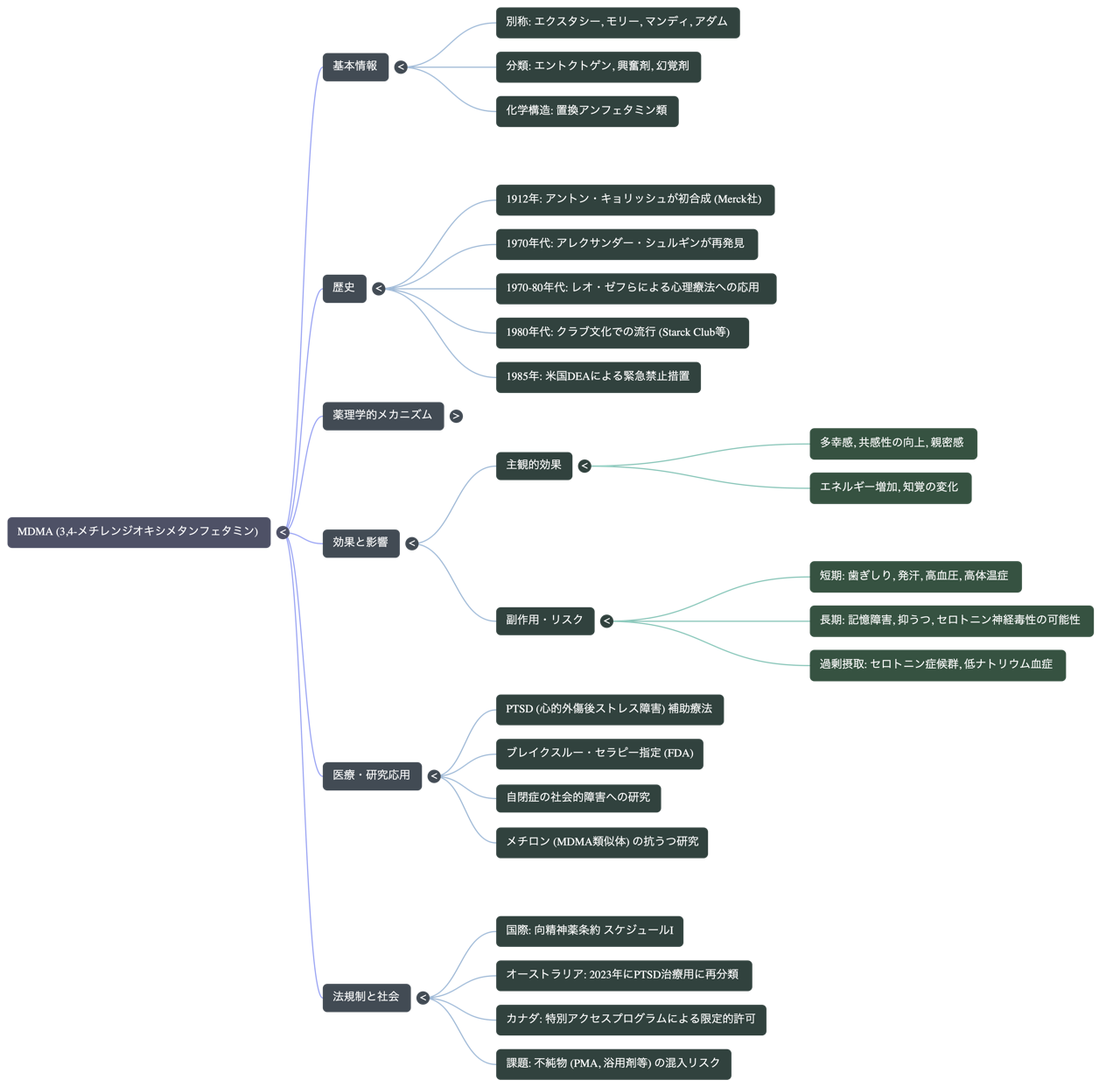
Chapter 3: From Forbidden to Treated: The Extraordinary 100-Year History of MDMA
1912: Born as a "by-product" of Merck & Co.
The story of MDMA is surprisingly about a major German pharmaceutical company.MerckIt begins here. In 1912, chemist Anton Kirsch first created MDMA as an intermediate in the process of synthesizing a competing hemostatic agent. It was then called "methylsafrylamin." Because it was not the intended drug, its unique pharmacological effects went unnoticed and were left undiscovered.
1976: The legendary chemist "rediscovers" the "Window"
The person who broke the approximately 60-year slumber was an American pharmacologist.Alexander ShulginThat's right. In 1976, he synthesized and took it himself and was amazed by the "feeling that the world was transparent," and he called this substance "WindowHe named it "".
Shulgin recounted this experience to a veteran psychotherapist who was considering retirement.Leo ZeffHe shared it with Zeff, who was so impressed by its effects that he reversed his retirement. He described it as "a substance that returns you to the innocence of the Garden of Eden.""Adam"He named this group "Underground School" and, through its underground network, provided therapy to approximately 4,000 patients and trained more than 150 therapists. This "Underground School" became the foundation of modern clinical research.
Therapists primarily expected three therapeutic effects from MDMA.① Reduction of fear of trauma, ② Release of emotions that are difficult to verbalize, ③ Awakening of deep empathy for oneself and others..
1984: Released on the market as "Ecstasy," sparking a Texas frenzy.
However, the "secret medicine" from the treatment room eventually leaks into a market rife with greed.Michael CraigBut"EcstasyThe product name was changed to "[product name]", and it was launched as a "legitimate business" with a pyramid sales network using a toll-free 1-800 number and accepting credit card payments.
The symbol of this is a French designerPhilippe StarckThe legendary Dallas club that he worked onStarck ClubWith its unmarked entrance, sunken dance floor, and gender-neutral restrooms—which were avant-garde for the time—this space became a melting pot for SMU students, the LGBTQ+ community, and celebrities alike.
1985: Political decisions closed the door to science.
Rapid popularizationMoral panicThis led to a situation where the media competed to report on MDMA as a "dangerous drug that corrupts young people," leaving no room for scientific discussion. Against the backdrop of this social fear, in 1985, at the strong urging of Senator Lloyd Bentzen, the DEA (U.S. Drug Enforcement Administration) classified MDMA as the highest regulatory category, without a thorough examination of its scientific and medical value.Schedule IIt was designated an emergency case. Research into its therapeutic potential was almost completely halted for a time.
1988: From Ibiza to British rave culture, spreading to the world.
Even after the regulations were put in place, MDMA went underground and spread to the world through other routes. Followers of the Indian spiritual leader Rajneesh saidSanyasinThey incorporated it as part of their spiritual training and brought it to places like Ibiza in Spain and Goa in India.
In 1988, young British people who returned from Ibiza saidSecond Summer of LoveThis sparked a new phenomenon. The repetitive bass of acid house and the sensory-amplifying effects of MDMA perfectly synchronized, creating an unprecedented social phenomenon in which "young people in British society, who had previously been divided by class and race, became one on the dance floor for the first time." However, in the shadow of this frenzy, tragedies from uncontrolled use were also piling up.
Chapter 4: Japan's "Invisible Crisis": The Rising Trend of Mental Illness and Suicide
The reason behind Otsuka Pharmaceutical's bold move was not only business logic, but alsoA serious reality that Japan is not fully facing.There is.
Explosive increase in the number of people with mental illness
According to statistics from the Ministry of Health, Labour and Welfare, the number of outpatients with mental illness in Japan isApproximately 586 million people as of 2020It has reached that level, more than double what it was 12 years ago. The fact that the 6 White Paper on Health, Labour and Welfare featured "mental health" as its special theme also illustrates the seriousness of the situation. (Source:令和6年版厚生労働白書)
The percentage of people who perceive stress that can cause mental illness as their greatest health risk is:It has tripled in the last 20 years.It increased to (2024 survey: 15.6%). According to WHO estimatesThe estimated number of people suffering from depression in Japan is approximately 506 million.Therefore, it ranks second in the Asia-Pacific region, after China. (Source:Explanation of the number of patients with mental illness and the current state of depression)
In the distribution of depression patients in Japan,Men in their 40s, women in their 30s and olderThere is a peak in this period. The reality is that those in their prime working years and those raising children are suffering the most.
The structural problem of "being unable to be cured with existing medications"
More serious is,There are a great many patients who do not improve with existing treatments.This is the point. Only 30-40% of patients achieve "remission" (a state of complete calm) with antidepressants (SSRIs and SNRIs), which are the standard treatment for depression. 60-70% of patients are in a state where they "do not experience sufficient relief." (Source:Otsuka Pharmaceutical's Abilify Approval Application News Release, 2012)
This is the fundamental reason why Otsuka Pharmaceutical is investing in MDMA-like substances, which have a completely different mechanism of action than conventional antidepressants.
The unfortunate record of having the worst suicide rate in the G7.
Another issue that cannot be overlooked is suicide. The suicide rate in Japan (per 10 people) isConsistently the highest level among the G7 (Group of Seven) countries.It is located in [location]. In 2024, the number of suicides in the country was approximately 20,268, and the suicide rate was 16.4 per 100,000 people, which is about 1.8 times the world average (9.1). (Source:Ministry of Health, Labour and Welfare, 6 White Paper on Suicide Prevention)
The data for young people is particularly shocking.Japan is the only G7 country where suicide is the leading cause of death among 10-19 year olds.That's right. In 2024, the number of suicides among elementary, junior high, and high school students reached a record high of 529, and for the first time, the number of girls surpassed the number of boys, an abnormal situation. (Source:The current state of child suicide: Kids Door)
| Suicide mortality rates in G7 countries (per 10 people, estimated) |
|---|
| 🇯🇵 Japan:16.4(G7 lowest) |
| 🇺🇸 United States: Approximately 14.1 people |
| 🇫🇷 France: Approximately 13.8 people |
| 🇨🇦 Canada: Approximately 11.8 people |
| 🇩🇪 Germany: Approximately 8-12 people |
| 🇬🇧 United Kingdom: Approximately 7.9 people |
| 🇮🇹 Italy: Approximately 6.7 people (highest among G7 countries) |
(Source:International comparison of suicide rates in Japan)
The OECD once noted that Japan has a high incidence of suicides related to depression.An annual economic loss of $25.4 billionIt is estimated that this is causing the following problems. This is not merely a medical issue, but a problem that concerns the productivity and sustainability of society as a whole.
Chapter 5: The Psychedelic Renaissance, Science Opens the Door Again
The ban that lasted for 40 years has been lifted.
Approximately 40 years after the regulations were put in place, a trend has begun in the scientific world to directly study what were once considered "playthings." (Non-profit organization MAPS (multidisciplinary))サイケデリックThe research association has raised funds and conducted numerous clinical trials over many years, resulting in the accumulation of data showing that many patients with severe PTSD show dramatic improvement.
The FDA has deemed MDMA adjunctive therapy to be "Breakthrough TherapyIt was designated as such. Various discussions are ongoing during the approval review process, but the accumulation of scientific knowledge continues.
The "TSND-201 (methylone)" from Transcend, which Otsuka Pharmaceutical is acquiring, possesses therapeutic properties similar to MDMA,It has a rapid onset of action and low off-target activity.This is a "next-generation" empathy substance with clinical advantages. (Source:Transcend Therapeutics Official Announcement)
Chapter 6: Risks and Challenges, and the Realities We Must Face Calmly
When discussing the clinical application of MDMA, it would be dishonest to only speak optimistically. The following are known short-term side effects:
- Hyperthermia (high body temperature): Impairment of the body's temperature regulation function. In particular, use in inappropriate environments can lead to life-threatening fever.
- Hyponatremia (water intoxication)Taking in too much water out of fear of dehydration can cause a sharp drop in blood salt concentration, potentially leading to cerebral edema.
- Teeth clenching (bruxism): Involuntary tension in the jaw muscles.
- mental exhaustion: Severe depression and fatigue for several days after use due to a temporary depletion of serotonin.
- Heart valve disease riskContinuous monitoring of the long-term effects of binding to the 5-HT2B receptor is necessary.
All of these risks areControlled clinical environmentwithSupervision by a specially trained therapistThis can be significantly reduced. The problem is not the substance itself,Quality of use environment and managementIt is in.
Furthermore, in Japan, MDMA is currently strictly regulated under the Narcotics and Psychotropic Substances Control Law, and the path to clinical application will take time due to institutional constraints.
Conclusion: Beyond moral panic, what questions should we be asking ourselves?
The trajectory of MDMA over more than 100 years traces a complete cycle of "medical treatment → entertainment → regulation → medical treatment."
The excessive fear (moral panic) of the 1980s once closed the doors to science. But now, thanks to the power of data and reason, those doors are about to open again.
The fact that a major Japanese company with a conservative image like Otsuka Pharmaceutical has invested up to $12.25 billion in this area is more than just an investment.Proof that global trends in pharmaceuticals and healthcare are definitely changing.It is.
Japan has over 6 million people suffering from mental illness, and continues to have the highest suicide rate among the G7 countries. In the reality that 600-7% of patients cannot be helped with existing medications,We have a duty to look at the evidence before we form prejudices.Wouldn't that be the case?
The dream that Leo Zeff once poured into the name "Adam"—to return humanity to its fundamental state of innocence and to confront its own wounds—is now being seriously questioned again in a new form, "TSND-201," after all these years.
If reading this article can provide even a small boost of immunity to moral panic—enough to make you pause and think before making an emotional judgment the next time the media and those around you start making a fuss about "that drug again"—then nothing could make me happier.
Supplementary Information: Explanation of Key Terms
| the term | Description |
|---|---|
| MDMA | 3,4-Methylenedioxymethamphetamine. A psychotropic drug classified as an entactogen (empathy substance). |
| Methylon (TSND-201) | A substance similar to MDMA. A "next-generation" empathy agent characterized by a shorter onset of action. A leading product under development by Transcend. |
| PTSD | Post-traumatic stress disorder (PTSD) is a disorder in which trauma from an intense experience affects mental function over the long term. |
| Breakthrough Therapy specification | Priority review designation, granted by the FDA to promising new drugs, allows for accelerated development and closer collaboration with regulatory authorities. |
| Schedule I | This is the strictest classification in US drug regulations. It applies to substances deemed to have "no medical value and a high risk of abuse." |
| Enteractogen | A pharmacological classification meaning "internal contact." A group of substances that enhance empathy for others and self-acceptance. |
| MAPS | Multidisciplinary Association for Psychedelic Studies. A U.S. non-profit research organization that has led the medicalization of MDMA for decades. |
| Moral panic | A sociological concept. The phenomenon in which excessive social fear and moral criticism of a particular substance, group, or behavior stifles rational discussion. |
Main references and sources
- Otsuka Pharmaceutical's acquisition of Transcend Therapeutics: Official news release (March 27, 2026)
- Nikkei Shimbun: "Otsuka Pharmaceutical acquires US biotech company for 110 billion yen" (March 2026)
- Transcend Therapeutics Official Acquisition Announcement (English)
- Otsuka Pharmaceutical's Abilify: News Release Regarding Approval of Additional Indications for Depression and Depressive States (2013)
- Ministry of Health, Labour and Welfare, 6 White Paper on Health, Labour and Welfare (Mental Health)
- Ministry of Health, Labour and Welfare, 6 White Paper on Suicide Prevention (G7 Comparative Data)
- Current Status of Mental Health Care and Welfare (Ministry of Health, Labour and Welfare document)
- Photo by Pretty drugthings on Unsplash
Person who wrote this article